A friend of mine tried to get a home loan last year. Good salary, stable job at an IT company in Hyderabad, no major debts. Three banks rejected him. He was completely blindsided.
The reason? His CIBIL score was 634. He hadn’t checked it in four years. During that time, a credit card he thought he’d closed was still active and had a small outstanding amount sitting there silently — dragging his credit score India down every single month.
By the time he found out, he’d already applied to three banks. Each application triggered a hard inquiry on his credit report, dropping his score further. A fixable problem became a 14-month problem.
Don’t be that person. Here’s everything you need to understand about your CIBIL score — what it means, why it matters, and the 10 specific steps to improve it in 2026.
What Is a CIBIL Score and Why Does It Control Your Financial Life?
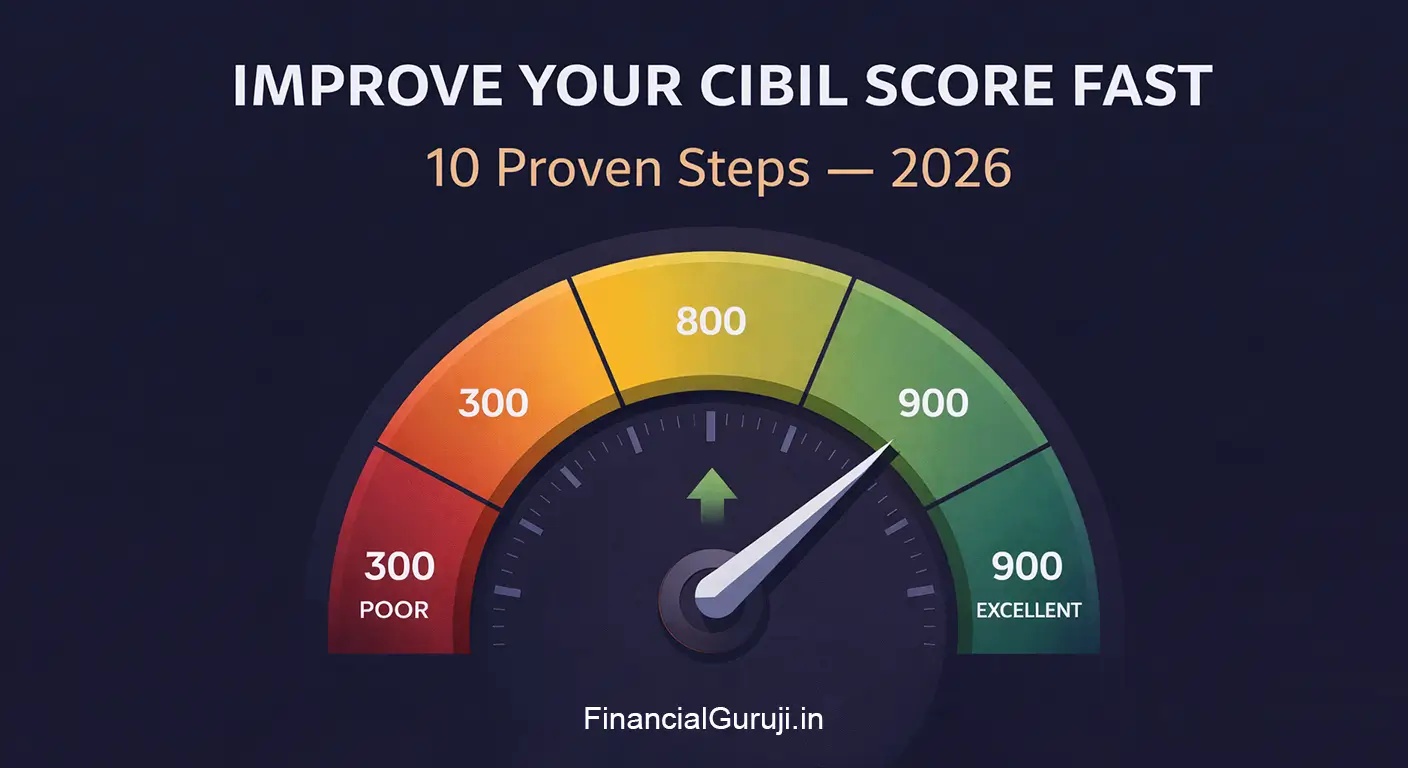
Your CIBIL score (also called credit score India) is a 3-digit number between 300 and 900, calculated by TransUnion CIBIL based on your credit history. Every time you borrow money — personal loan, home loan, car loan, credit card — lenders report your payment behaviour to CIBIL. That data becomes your credit report, and the score is a summary of how reliably you repay.
Banks, NBFCs, and digital lenders check this number before approving any credit. A higher score means faster approval and better interest rates. A low score means rejection or expensive loans.
CIBIL Score Range — What Your Number Actually Means
| Score Range | Rating | What It Means for Loan Approval |
| 750 – 900 | Excellent | High approval chance, lowest interest rates, best terms |
| 700 – 749 | Good | Strong approval chances, standard rates |
| 650 – 699 | Fair | Possible but lenders add conditions, higher interest |
| 600 – 649 | Poor | Most banks reject, some NBFCs may lend at high rates |
| 300 – 599 | Very Poor | Near-certain rejection from all formal lenders |
| -1 or NH | No History | No credit file — treated cautiously, build credit first |
| Target: 750 and above. This is where most banks offer their best home loan and personal loan interest rates. The minimum CIBIL score for home loan approval at most public sector banks is 700. Private banks and top NBFCs typically want 720+. |
How to Check Your CIBIL Score Free in 2026
Under RBI guidelines, every individual is entitled to one free credit report per year from each credit bureau. There are four bureaus in India — CIBIL, Experian, Equifax, and CRIF High Mark.
- CIBIL free check: cibil.com → ‘Get Your Free CIBIL Score’ (one free per year)
- Paisabazaar: Free CIBIL score check, unlimited refreshes, shows full report
- BankBazaar: Free score with report — good for seeing all accounts
- OneScore app: Free, shows real-time updates when score changes
- Bajaj Finserv: Free CIBIL score check without affecting your credit score
Checking your own score is called a soft inquiry and does NOT affect your CIBIL score. Always start here before doing anything else — know your exact number and read your full credit report carefully.
The 5 Factors That Build Your CIBIL Score
| Factor | Weight | What It Means |
| Payment History | 35% | Do you pay EMIs and credit card bills on time? Most critical factor. |
| Credit Utilisation Ratio | 30% | What % of your credit card limit are you using? Keep below 30%. |
| Credit History Length | 15% | How long have your oldest accounts been open? Longer is better. |
| Credit Mix | 10% | Do you have both secured (loans) and unsecured (cards) credit? |
| New Credit / Inquiries | 10% | How many new loans/cards have you applied for recently? |
Understanding these five factors tells you exactly where your score is weak and which actions will have the most impact.
10 Proven Steps to Improve Your CIBIL Score in 2026
Step 1 — Check Your Full Credit Report for Errors
Before doing anything else, read your full credit report — not just the score. Credit report errors are more common than most people realise. Look for:
- Loans or credit cards you never took (identity fraud or data error)
- Payments marked ‘late’ that you actually paid on time
- Accounts still showing as ‘open’ after you closed them
- Wrong personal information — wrong PAN or date of birth
If you find errors, raise a CIBIL dispute online at cibil.com → ‘Dispute Centre’. Submit your dispute with supporting documents (bank statement, payment receipt). CIBIL must resolve it within 30 days by law. Fixing one major error can add 50–100 points to your score — this is the fastest route to how to increase credit score fast when errors exist.
Step 2 — Pay Every Bill On Time, Without Exception
Payment history is 35% of your CIBIL score — the single largest factor. One missed EMI or credit card payment can drop your score by 50–100 points. Consistently on-time payments are the foundation of a good credit score India.
Practical tip: Set up auto-pay for the minimum due amount on every credit card. This guarantees you never miss a due date even when you forget. Then manually pay the full balance whenever you can.
| Never miss the due date — even if you can only pay the minimum. Partial payment on time is far better than full payment one day late. A single ‘Days Past Due’ entry on your CIBIL report can take 12 months to stop negatively affecting your score. |
Step 3 — Fix Your Credit Utilisation Ratio
Credit utilisation ratio = (total credit card balance ÷ total credit limit) × 100. This factor carries 30% weight — the second most important.
| Monthly Spend | Credit Limit | Utilisation % | Impact on Score |
| ₹80,000 | ₹1,00,000 | 80% | Very negative — appears financially stressed |
| ₹50,000 | ₹1,00,000 | 50% | Moderate — borderline acceptable |
| ₹28,000 | ₹1,00,000 | 28% | Good — within ideal range |
| ₹15,000 | ₹1,00,000 | 15% | Excellent — signals responsible usage |
Keep your credit utilisation ratio below 30% at all times — ideally below 20%. Two ways to achieve this: spend less on your cards, or request a credit limit increase from your bank. Both lower the ratio and improve your score.
Step 4 — Never Close Your Oldest Credit Cards
Credit history length accounts for 15% of your CIBIL score. The age of your oldest account and the average age of all your accounts both matter. Closing an old card reduces your average credit history length and increases your utilisation ratio simultaneously — a double hit.
Unless a card has a high annual fee you genuinely cannot justify, keep it open. Use it for one small transaction every 2–3 months to prevent the bank from closing it due to inactivity.
Step 5 — Never Apply for Multiple Loans at the Same Time
Every time you apply for a loan or credit card, the lender does a hard inquiry on your credit report. Each hard inquiry drops your score by 5–10 points — and stays on your report for 2 years.
Applying to five banks in one week = five hard inquiries = potentially 50 points lost — making your loan approval even harder.
The right approach: use eligibility check tools on Paisabazaar or BankBazaar. These run a soft inquiry (no score impact) to show you which lenders you pre-qualify for. Then apply to one or two. This is the most overlooked credit score improvement tip.
Step 6 — Clear All Overdue Amounts Immediately
Any account marked ‘overdue’, ‘DPD’ (Days Past Due), or ‘NPA’ (Non-Performing Asset) is actively damaging your score every month it remains unpaid. These must be your first priority.
After clearing the overdue amount: call the lender and ask them to update the account status with CIBIL as ‘Closed’ or ‘Regular’. Follow up — this can take 45–90 days to reflect on your credit report. Do not wait passively.
Step 7 — Build Credit With a Secured Credit Card (If You Have No History)
If your CIBIL score shows -1 or NH (No History), or if your score is below 600 and no bank will give you a regular credit card, a secured credit card is your fastest path to building credit history.
How it works: You deposit ₹10,000–₹25,000 as collateral with a bank. They give you a credit card with that amount as your limit. You use it for small purchases (groceries, phone bill) and pay the full balance every month. After 6–12 months of consistent usage, your CIBIL score builds from nothing to a respectable 680–720.
Banks offering secured credit cards in India: SBI Unnati, ICICI Coral against FD, Axis Bank Insta Easy. The secured credit card India route is slower than fixing errors but reliable for those starting from zero.
Step 8 — Maintain a Healthy Credit Mix
Credit mix accounts for 10% of your score. Having only credit cards (unsecured credit) is less ideal than having a mix of secured loans (home loan, car loan) and unsecured credit (credit cards, personal loan).
Don’t take a loan just to improve your score — that makes no financial sense. But if you have a genuine need (buying a vehicle, education loan), taking a loan and repaying it on time actively builds your credit profile over time.
Step 9 — Become an Authorised User on a Family Member’s Card
If a family member (parent, spouse) has a credit card with excellent history and high limit, ask to be added as an authorised user. Their positive payment history and low utilisation on that card gets reflected on your credit report too.
This is a legitimate and legal credit score improvement tip in India. It’s especially useful for young people with thin credit files who need a score boost quickly.
Step 10 — Be Patient — Consistent Behaviour Over Time
There is no 48-hour CIBIL score fix, despite what some WhatsApp forwards claim. Legitimate improvement takes time. Here’s a realistic timeline:
| Action Taken | Expected Score Impact | Timeframe |
| Fix credit report errors | +50 to +100 points | 30–60 days after dispute resolution |
| Clear all overdue accounts | +30 to +60 points | 45–90 days after payment + lender update |
| Reduce credit utilisation below 30% | +20 to +40 points | 30–60 days after next billing cycle |
| Consistent on-time payments (6 months) | Steady improvement | 6 months |
| Full credit rebuild (600 → 750+) | +150 points | 12–18 months of consistent behaviour |
What Is the Minimum CIBIL Score for Different Loans?
| Loan Type | Minimum CIBIL Score | Best Rate Eligibility |
| Home loan (PSU banks) | 700 | 750+ |
| Home loan (private banks) | 720 | 760+ |
| Personal loan | 700 | 740+ |
| Car loan | 680 | 730+ |
| Credit card (basic) | 650 | 720+ |
| Business loan | 700 | 750+ |
| Gold loan / loan against FD | No minimum (secured) | N/A |
Knowing the minimum CIBIL score for home loan before applying saves you from unnecessary hard inquiries that would hurt your score further. Check your score first, improve it if needed, then apply.
→ Use our Home Loan Eligibility Calculator and EMI Calculator to plan your loan after improving your score
Frequently Asked Questions
How long does it take to improve CIBIL score from 600 to 750?
Realistically, 12–18 months of consistent on-time payments, low credit utilisation ratio, and zero new missed payments. If you also fix errors and clear overdues early, you can see significant improvement in 6–9 months. There is no shortcut — anyone promising a faster fix is likely running a scam.
Does checking my own CIBIL score hurt it?
No. Checking your own score is a soft inquiry and has zero impact on your CIBIL score. Only lenders doing a hard inquiry (when you apply for credit) affects your score. Check your score as often as you like.
I settled a loan for less than the full amount. Does that hurt my score?
‘Settled’ status is better than ‘written off’ or ‘NPA’, but it still negatively impacts your CIBIL score. CIBIL marks it as ‘settled’ rather than ‘closed’, which signals that the debt wasn’t fully honoured. Wherever possible, pay the full amount and get ‘Closed’ status instead of settling.
Can I get a personal loan with a 650 CIBIL score?
Some NBFCs and fintech lenders (Bajaj Finance, MoneyTap, KreditBee) offer personal loans to borrowers with 650 credit score for personal loan applications — but at significantly higher interest rates (18–30% vs 11–14% for 750+ scores). It’s better to spend 3–6 months improving your score before applying.
What is a hard inquiry and how much does it drop my score?
A hard inquiry happens every time a lender formally pulls your credit report in response to a loan or credit card application. Each hard inquiry credit score impact is approximately 5–10 points and stays on your report for 2 years. Multiple applications in a short period signal financial stress to lenders and compound the negative impact.
How do I do a CIBIL dispute online for wrong information?
Go to cibil.com → ‘Dispute Centre’ → log in with your CIBIL account → select the account with incorrect information → choose the dispute type → upload supporting documents. CIBIL investigates with the lender and must resolve within 30 days. Track your dispute status in the same portal.