Every January and February, HR departments across India send out one email: submit your investment declarations and rent receipts for TDS calculation. Most employees rush to submit whatever they have. Many submit nothing at all — and end up paying significantly more tax than they legally need to.
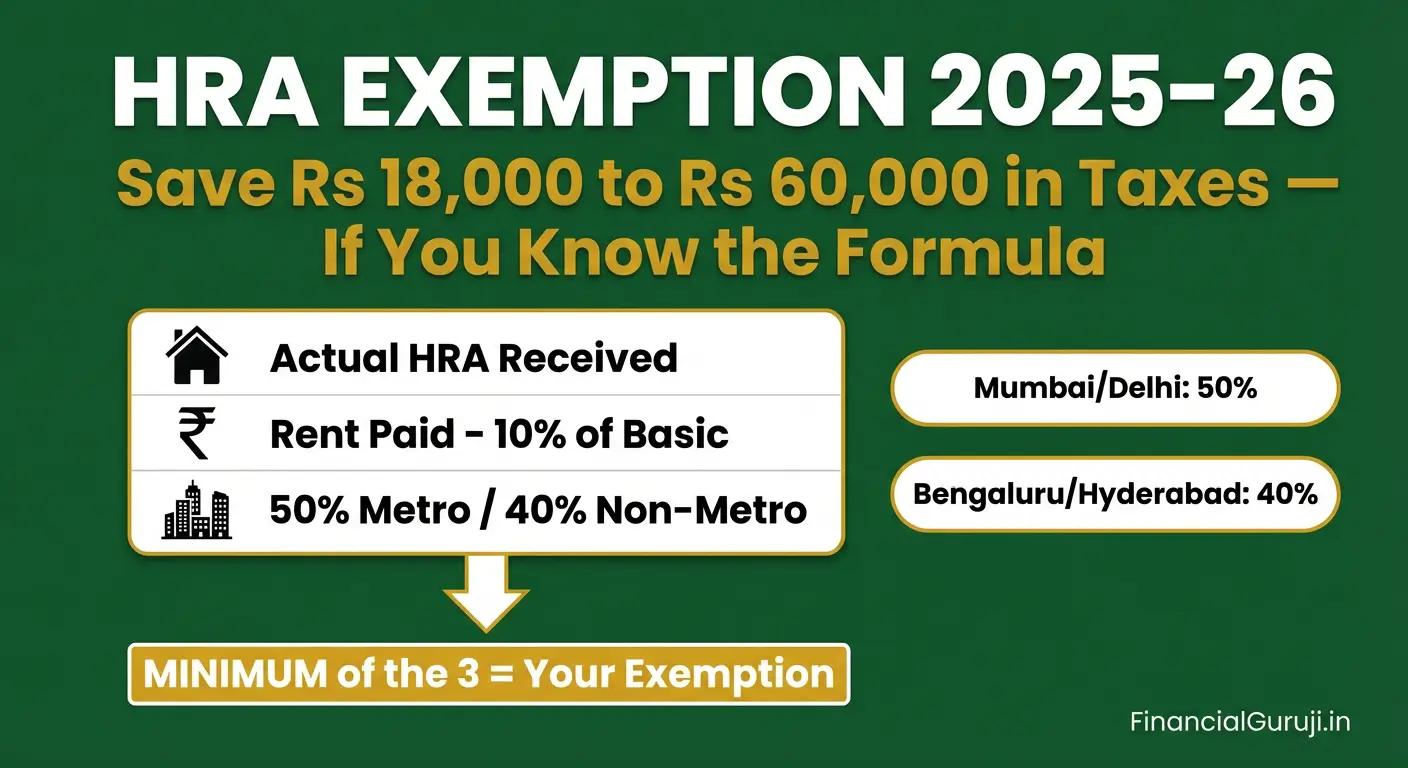
HRA exemption is one of the largest potential tax deductions for salaried employees who live in rented accommodation. Depending on your salary and city, it can reduce your taxable income by Rs 60,000 to Rs 2 lakh per year. For someone in the 30% tax slab, that is Rs 18,000 to Rs 60,000 in actual tax saved every year.
Yet the rules are specific enough that many people claim less than they are entitled to — or miss the deduction entirely. This guide covers every rule, every exception, and the exact calculation steps.
What Is HRA and Who Can Claim It
HRA stands for House Rent Allowance. It is a component of your salary structure — a portion of your CTC specifically designated for meeting rental expenses. If your employer includes HRA in your salary and you live in rented accommodation, you are eligible to claim HRA exemption from income tax.
| Condition | Eligible? | Notes |
| Salaried employee with HRA component in salary | Yes | HRA must be explicitly part of your CTC structure |
| Self-employed professional | No | Section 10(13A) applies only to salaried. Self-employed can claim under Section 80GG instead |
| Living in own house | No | Must be living in rented accommodation to claim |
| Paying rent to family member | Yes | Paying rent to parents is allowed. Paying to spouse is not allowed. |
| Working from hometown, renting there | Yes | As long as you are paying rent and have proof |
| New tax regime | No | HRA exemption is not available in the new tax regime |
| HRA exemption is ONLY available in the old tax regime. If you have opted for the new tax regime, this deduction does not apply — which is a major reason why high-rent salaried employees in metros should carefully compare both regimes before choosing. |
The HRA Exemption Calculation Formula
The HRA exemption amount is the MINIMUM of these three values. Calculate all three and the lowest number is your exempt HRA.
| Component | Formula | What It Means |
| A — Actual HRA received | HRA component from your salary slip | What your employer pays you as HRA |
| B — Excess rent over 10% salary | Annual rent paid MINUS 10% of (Basic + DA) | Rent above the 10% threshold is considered genuinely needed |
| C — Percentage of salary | 50% of (Basic + DA) for metro cities 40% for non-metro cities | Cap based on your city classification |
Your HRA exemption = Minimum of A, B, and C
The remaining HRA received (Total HRA minus Exempt HRA) is added to your taxable income.
Metro vs Non-Metro — Which Cities Qualify as Metro
The 50% vs 40% HRA exemption split depends on whether your city of residence is classified as a metro. Only four cities qualify as metro for HRA purposes:
| City Classification | Cities | HRA Cap |
| Metro (50% of Basic+DA) | Delhi, Mumbai, Kolkata, Chennai ONLY | 50% of Basic + DA |
| Non-Metro (40% of Basic+DA) | ALL other cities including Hyderabad, Bengaluru, Pune, Ahmedabad, Noida, Gurugram, Kochi, Chandigarh, etc. | 40% of Basic + DA |
| Warning: Bengaluru and Hyderabad are NOT metro cities for HRA purposes despite being India’s largest IT hubs. Many IT employees in these cities wrongly calculate using 50% — the correct rate is 40%. This is the most common HRA calculation mistake in India. |
HRA Exemption Calculation — 6 Real Examples
All examples use annual figures. Basic + DA is used as the salary base for HRA calculation.
| Profile | Calc A: HRA Received | Calc B: Rent – 10% Salary | Calc C: % of Salary | Exemption (Min) | Tax Saved (30%) |
| Ravi, Hyderabad Basic Rs 4L, HRA Rs 1.5L Rent Rs 15K/month | Rs 1,50,000 | Rs 1,80,000 – Rs 40,000 = Rs 1,40,000 | 40% of Rs 4L = Rs 1,60,000 | Rs 1,40,000 | Rs 42,000 |
| Priya, Mumbai Basic Rs 5L, HRA Rs 2L Rent Rs 25K/month | Rs 2,00,000 | Rs 3,00,000 – Rs 50,000 = Rs 2,50,000 | 50% of Rs 5L = Rs 2,50,000 | Rs 2,00,000 | Rs 60,000 |
| Arjun, Bengaluru Basic Rs 6L, HRA Rs 2.4L Rent Rs 20K/month | Rs 2,40,000 | Rs 2,40,000 – Rs 60,000 = Rs 1,80,000 | 40% of Rs 6L = Rs 2,40,000 | Rs 1,80,000 | Rs 54,000 |
| Sneha, Noida Basic Rs 3L, HRA Rs 1L Rent Rs 8K/month | Rs 1,00,000 | Rs 96,000 – Rs 30,000 = Rs 66,000 | 40% of Rs 3L = Rs 1,20,000 | Rs 66,000 | Rs 19,800 |
| Kiran, Chennai Basic Rs 8L, HRA Rs 3.2L Rent Rs 30K/month | Rs 3,20,000 | Rs 3,60,000 – Rs 80,000 = Rs 2,80,000 | 50% of Rs 8L = Rs 4,00,000 | Rs 2,80,000 | Rs 84,000 |
| Tip: To maximise HRA exemption — increase your monthly rent until Component B (rent minus 10% of salary) equals Component A (HRA received). Beyond that point, extra rent does not increase your exemption. The optimal rent is: HRA received + 10% of Basic salary divided by 12 per month. |
Documents Required for HRA Claim
| Document | When Required | Where to Submit |
| Rent receipts (monthly or quarterly) | Always — for any HRA claim | HR department before January/February deadline |
| Rental agreement / lease deed | Recommended for all amounts | HR or keep for ITR filing |
| Landlord PAN card | Mandatory if annual rent exceeds Rs 1 lakh (Rs 8,333/month) | Submit copy to HR along with receipts |
| Landlord declaration (Form 60) | If landlord does not have PAN | HR department |
| Bank transfer proof | Strongly recommended — pay rent by UPI/NEFT/cheque | Keep for your records, submit if HR asks |
Landlord PAN for HRA: If your monthly rent exceeds Rs 8,333 (Rs 1 lakh per year), the landlord’s PAN is mandatory. Without it, your employer will not process the HRA exemption. If your landlord genuinely does not have PAN, you can submit a self-declaration from the landlord in Form 60.
| Tip: Always pay rent via bank transfer, UPI, or cheque — never cash for amounts above Rs 8,333 per month. Cash rent payments are difficult to prove and tax officers can question them during scrutiny. Digital payment creates an automatic audit trail. |
HRA Exemption Without Rent Receipts
Can you claim HRA without rent receipts? Technically, for rent below Rs 3,000 per month (Rs 36,000 per year), employers can accept a self-declaration instead of receipts. But this threshold is outdated and most employers still ask for receipts regardless.
For practical purposes: always collect rent receipts. If your landlord refuses to give receipts, create a simple receipt yourself, have the landlord sign it, and keep a copy. A signed receipt takes 2 minutes to prepare and protects Rs 30,000 to Rs 1.5 lakh in tax exemption.
If you missed submitting receipts to HR for TDS purpose — you can still claim HRA exemption in your ITR filing directly. The deduction applies as long as you actually paid rent, even if your employer processed TDS without it.
Rent Paid to Parents — Completely Legal
One of the most effective but underused HRA strategies: pay rent to your parents if you live in their house.
- You can pay rent to your parents and claim HRA exemption — the transaction is completely legal
- Your parents receive the rent as income — but if their total income is below the taxable limit, they pay zero tax on it
- Net result: you save 20-30% in taxes on the HRA exemption, your parents receive legitimate rental income
- Requirements: actual rent must be paid — by bank transfer, not cash. Rental agreement between you and parents is recommended. Parents must show this as rental income in their ITR.
| Example: Suresh lives in his parents house in Hyderabad. Basic salary Rs 5 lakh. HRA Rs 2 lakh. He pays his parents Rs 15,000/month (Rs 1.8L/year) rent via bank transfer. He claims HRA exemption of Rs 1.4 lakh. Tax saved at 30% = Rs 42,000. Parents receive Rs 1.8L rental income — below taxable limit after standard deduction. Net family tax saving: Rs 42,000 per year. |
HRA and Home Loan — Can You Claim Both?
Yes — you can claim both HRA exemption and home loan deductions simultaneously. This is one of the most common questions and the answer surprises many people.
| Scenario | HRA Exemption | Home Loan Deduction | Both Together? |
| Own house in same city, live there | No — cannot claim HRA if living in own house | Section 24b interest up to Rs 2L | Only home loan deduction |
| Own house in different city, renting in work city | Yes — paying rent in work city | Section 24b interest on own house | Yes — both allowed |
| House under construction, renting now | Yes — renting while waiting for possession | No 24b yet — pre-construction interest later | Yes — HRA now, 24b after possession |
| Own house let out, self renting elsewhere | Yes — you are renting | Section 24b on let-out (no cap) | Yes — both allowed |
The most common dual-benefit scenario: you bought a house in your hometown (Vijayawada) but work and rent in Bengaluru. You claim HRA for Bengaluru rent AND Section 24b interest on your Vijayawada home loan simultaneously. Both deductions are fully valid.
HRA Declaration to Employer — Timeline and Process
- January to February: HR sends investment declaration form — submit rent receipts and landlord details
- If you missed the HR deadline: you can still claim in ITR filed by July 31, 2026
- For ITR claim: use Schedule S (Salary) in ITR — enter actual HRA received and exempt amount calculated by the formula
- Keep all rent receipts for 6 years — income tax scrutiny can go back up to 6 assessment years
- If your employer did not give HRA exemption in Form 16: claim it yourself in ITR and get refund
| Tip: Missed submitting receipts to HR? Do not panic. Submit to HR even after the deadline — many employers accept late submissions till March end for TDS adjustment. If HR does not accept, claim in ITR directly and get the tax refund after July filing. |
HRA for Self-Employed — Section 80GG
Self-employed individuals and those who do not receive HRA as part of salary can claim rent deduction under Section 80GG — a separate provision with different rules.
- Maximum deduction under 80GG: Rs 5,000 per month (Rs 60,000 per year)
- Condition: neither you nor your spouse nor minor child should own a house in the city where you reside
- Deduction is minimum of: Rs 5,000/month, 25% of total income, or actual rent minus 10% of income
- File Form 10BA declaration before claiming 80GG
Note: Section 80GG limit of Rs 60,000 per year is significantly lower than Section 10(13A) HRA exemption for salaried employees. If you have a choice between salaried and self-employed structure, the salaried HRA benefit is substantially larger.
Use our HRA Calculator — enter your Basic salary, HRA received, rent paid, and city to get your exact exemption amount in seconds
Frequently Asked Questions
What is the HRA exemption limit for FY 2025-26?
There is no fixed rupee cap on HRA exemption — it depends on your individual calculation. The exempt amount is the minimum of: actual HRA received, rent paid minus 10% of Basic+DA, and 50% (metro) or 40% (non-metro) of Basic+DA. For a person with Rs 6 lakh Basic in Hyderabad paying Rs 20K rent, the exemption works out to Rs 1.8 lakh.
Can I claim HRA if I am in the new tax regime?
No. HRA exemption under Section 10(13A) is not available in the new tax regime. This is one of the key financial reasons why salaried employees paying significant rent in metros should calculate carefully before choosing the new regime — the HRA deduction alone can be worth Rs 30,000 to Rs 1 lakh in tax savings annually in the old regime.
I pay rent to my parents. Can I claim HRA?
Yes — rent paid to parents is a valid HRA claim. You need a rental agreement with your parents, pay rent via bank transfer (not cash), and your parents must declare this rental income in their ITR. This is a completely legal and widely used tax planning strategy. Paying rent to spouse is NOT allowed.
What if my landlord does not give me a PAN for HRA?
If your annual rent exceeds Rs 1 lakh and the landlord does not have PAN, ask them to sign Form 60 (a declaration that they do not have PAN). This is accepted by most employers as an alternative. Without PAN or Form 60, your employer cannot process the HRA exemption for TDS — but you can still claim it in ITR.
I own a house in Hyderabad but rent in Bengaluru for work. Can I claim both HRA and home loan deductions?
Yes — this is one of the most legitimate dual-benefit scenarios. You claim HRA exemption for the Bengaluru rent you pay, and Section 24b home loan interest deduction on your Hyderabad property simultaneously. Both are fully allowed as long as you are genuinely paying rent in the city where you work.
My employer processed TDS without HRA exemption. How do I get it back?
Claim the HRA exemption in your ITR filing (due July 31, 2026). In ITR, under Schedule S (Salary details), enter the HRA received and calculate the exempt portion using the formula. The difference between tax paid (TDS) and tax actually owed will show as a refund — credited to your bank account typically within 2 to 8 weeks of ITR processing.