
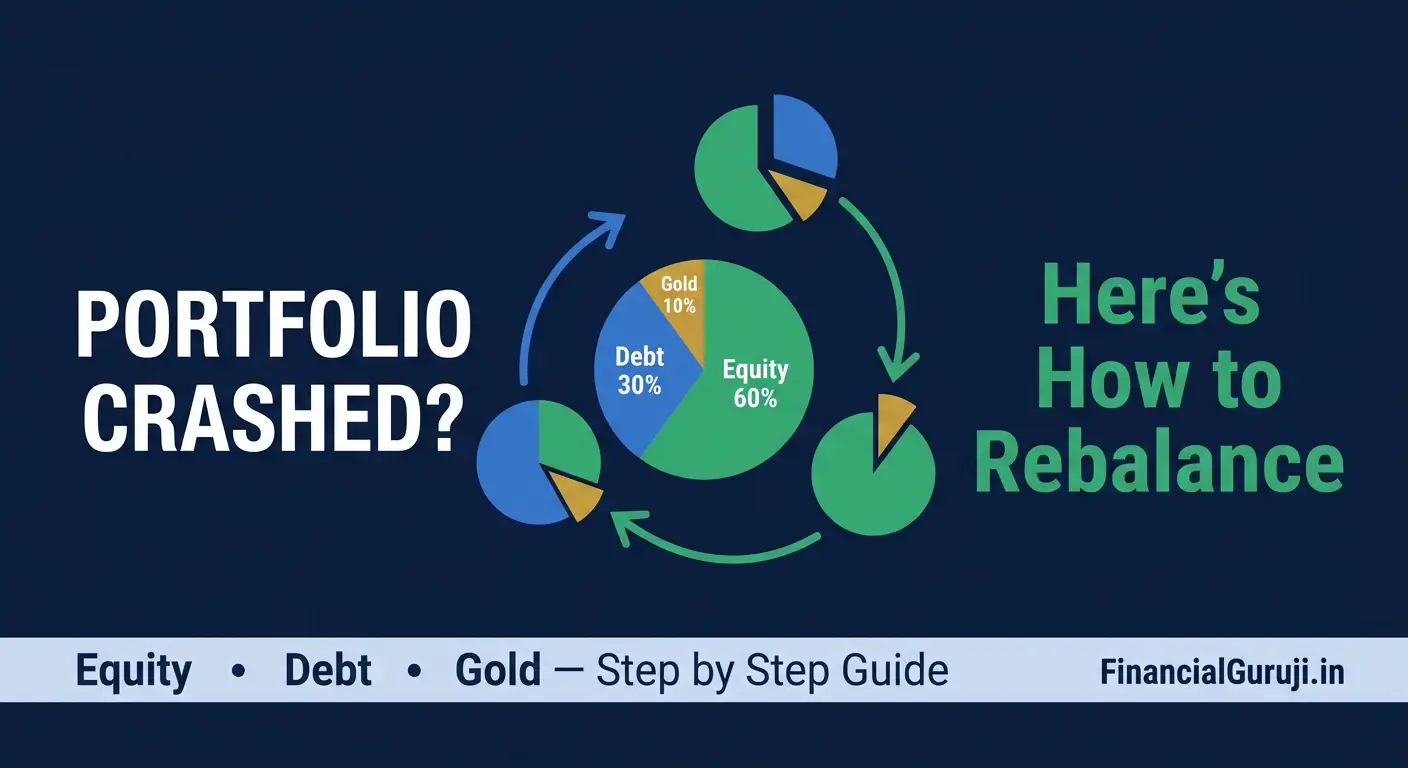
How to rebalance your portfolio during a market crash is the most important question every Indian investor must answer right now.
Your portfolio is down. Nifty has lost 7-10% in 10 days. Iran war, Trump tariffs, crude oil above $120 — everything hit at once.
Most investors do one of two things right now: panic and sell everything, or freeze and do nothing.
There is a third option — and it is the one that actually builds wealth during market crashes. It is called portfolio rebalancing.
What Is Portfolio Rebalancing?
Portfolio rebalancing is simply bringing your investments back to your original planned allocation after markets have moved them away from it.
Here is a simple example:
You started the year with this allocation:
- Equity (Nifty 50 index fund + mutual funds): 60%
- Debt (PPF + FD + debt mutual funds): 30%
- Gold (Gold ETF): 10%
After the crash, your portfolio looks like this today:
- Equity: 52% (fell because market is down)
- Debt: 36% (stayed stable)
- Gold: 12% (rose because war = gold demand)
Your portfolio has drifted away from your plan. Rebalancing means bringing it back to 60-30-10.
How? By buying more equity (which is now cheaper) and trimming some gold (which has risen).
In other words — rebalancing forces you to buy low and sell high automatically, without any guesswork.
Why Market Crashes Are Actually the Best Time to Rebalance
This sounds counterintuitive. Why buy more equity when it is falling?
Because you are not guessing where the market will go. You are simply following your own plan.
Consider what happened in every major crash:
| Crisis | What Rebalancers Did | Result |
|---|---|---|
| 2008 Financial Crisis | Bought equity at -60% lows | 3x returns by 2013 |
| 2020 COVID Crash | Bought equity in March 2020 | Nifty doubled by Dec 2021 |
| 2022 Russia-Ukraine War | Bought equity at -12% | Recovered in 4 months |
| 2026 Iran War | Buying equity now at -7-10% | History suggests recovery |
The investors who froze or sold during these crashes locked in their losses. The investors who rebalanced — bought more equity at lower prices — captured the full recovery.
The 3 Portfolio Types — Which One Are You?
Before rebalancing, identify your investor type:
Type 1 — Conservative (Age 50+, near retirement) Target allocation: 40% Equity | 50% Debt | 10% Gold If your equity has fallen below 35%, buy some equity to bring it back to 40%.
Type 2 — Moderate (Age 35-50, 10-20 year horizon) Target allocation: 60% Equity | 30% Debt | 10% Gold If your equity has fallen below 55%, buy equity to restore 60%.
Type 3 — Aggressive (Age 25-35, 20+ year horizon) Target allocation: 75% Equity | 15% Debt | 10% Gold Market crash is your biggest opportunity — equity is on sale.
Step-by-Step: How to Rebalance Your Portfolio Right Now
Step 1 — Calculate Your Current Allocation
Open your Zerodha, Groww, or Kuvera app. List the current value of:
- All equity mutual funds and stocks
- All debt investments (FD, PPF, debt funds)
- Gold (Gold ETF, Sovereign Gold Bond)
Calculate what percentage each is of your total portfolio.
Step 2 — Compare to Your Target
Check how far you have drifted from your original plan.
The ±5% Rule: If any asset class has drifted more than 5% from your target — it is time to rebalance. If equity was 60% and is now 52% — that is an 8% drift. Rebalance.
If the drift is less than 5% — leave it. Transaction costs and taxes are not worth it for small drifts.
Step 3 — Choose Your Rebalancing Method
Method 1 — Fresh Investment (Best for salaried investors) Instead of selling anything, direct your next lumpsum or increase your SIP into equity. No tax, no selling, no paperwork.
Example: You have ₹50,000 sitting in savings account. Put it all into your Nifty 50 index fund. This increases your equity allocation back toward target.
Method 2 — Sell and Reinvest Sell some gold (which has risen) and buy equity (which has fallen). Important: Check capital gains tax before selling. Gold held less than 3 years attracts short-term capital gains tax at your income tax slab rate.
Method 3 — Stop Debt SIP, Increase Equity SIP Temporarily If you have both equity and debt SIPs running, pause the debt SIP for 2-3 months and redirect that amount to equity. Resume once allocation is restored.
Step 4 — Set a Reminder to Review
Rebalancing is not a daily activity. Set a calendar reminder for:
- Every 6 months — check allocation
- Immediately — if any asset class drifts more than 10% from target
What About Gold Right Now?
Gold has been the standout performer during this crisis. In January 2026 alone, gold ETFs gained over 22%. During the Iran war, gold crossed ₹1,64,000 per 10 grams.
Should you buy more gold now?
No — and here is why.
Gold’s role in your portfolio is as insurance, not as a return driver. The standard recommendation is 10% gold allocation. If yours has drifted above 15% due to recent gains — this is actually a good time to trim some gold and move into equity.
Gold has already priced in most of the war fear. Equity has not yet priced in the recovery.
The 3 Mistakes to Avoid While Rebalancing
Mistake 1 — Rebalancing too often Every time markets move 1-2%, do not rebalance. Transaction costs and taxes will eat your returns. Stick to the ±5% rule.
Mistake 2 — Ignoring taxes Selling equity mutual funds held less than 1 year attracts 20% STCG tax. Selling gold ETFs held less than 3 years attracts slab rate tax. Always calculate post-tax returns before selling.
Mistake 3 — Abandoning your target allocation Some investors see equity falling and permanently reduce their equity target from 60% to 40% out of fear. This is the worst decision — you are permanently reducing your long-term return potential based on short-term fear.
A Real Example — Arjun’s Portfolio, March 2026
Arjun, 32 years old, IT professional in Hyderabad. Portfolio before the crash:
| Asset | Amount | Allocation |
|---|---|---|
| Nifty 50 Index Fund | ₹6,00,000 | 60% |
| PPF + Debt Fund | ₹3,00,000 | 30% |
| Gold ETF | ₹1,00,000 | 10% |
| Total | ₹10,00,000 | 100% |
After Iran war crash — March 13, 2026:
| Asset | Amount | Allocation |
|---|---|---|
| Nifty 50 Index Fund | ₹5,30,000 | 53% |
| PPF + Debt Fund | ₹3,00,000 | 30% |
| Gold ETF | ₹1,70,000 | 17% |
| Total | ₹10,00,000 | 100% |
Arjun’s equity drifted from 60% to 53% — a 7% drift. Gold went from 10% to 17% — a 7% drift upward.
Rebalancing action: Arjun sells ₹70,000 of Gold ETF (held over 3 years, so 12.5% LTCG applies on gains only) and puts ₹70,000 into Nifty 50 index fund.
Result: Portfolio back to 60-30-10. Arjun bought equity at crash prices. When market recovers, those extra units mean extra profit.
Key Takeaways
- Portfolio rebalancing means bringing your investments back to your original target allocation after markets move them
- Market crashes are actually the best time to rebalance — equity is cheaper, you are buying low
- The ±5% rule: rebalance only when any asset class drifts more than 5% from target
- Best method for salaried investors: use fresh money or increase equity SIP instead of selling
- Check capital gains tax before selling anything
- Target allocation: Conservative 40-50-10 | Moderate 60-30-10 | Aggressive 75-15-10
- Do not change your long-term target allocation based on short-term fear
Disclaimer: This article is for informational purposes only and does not constitute investment advice. Please consult a SEBI-registered financial advisor before making investment decisions. All investments carry market risk.