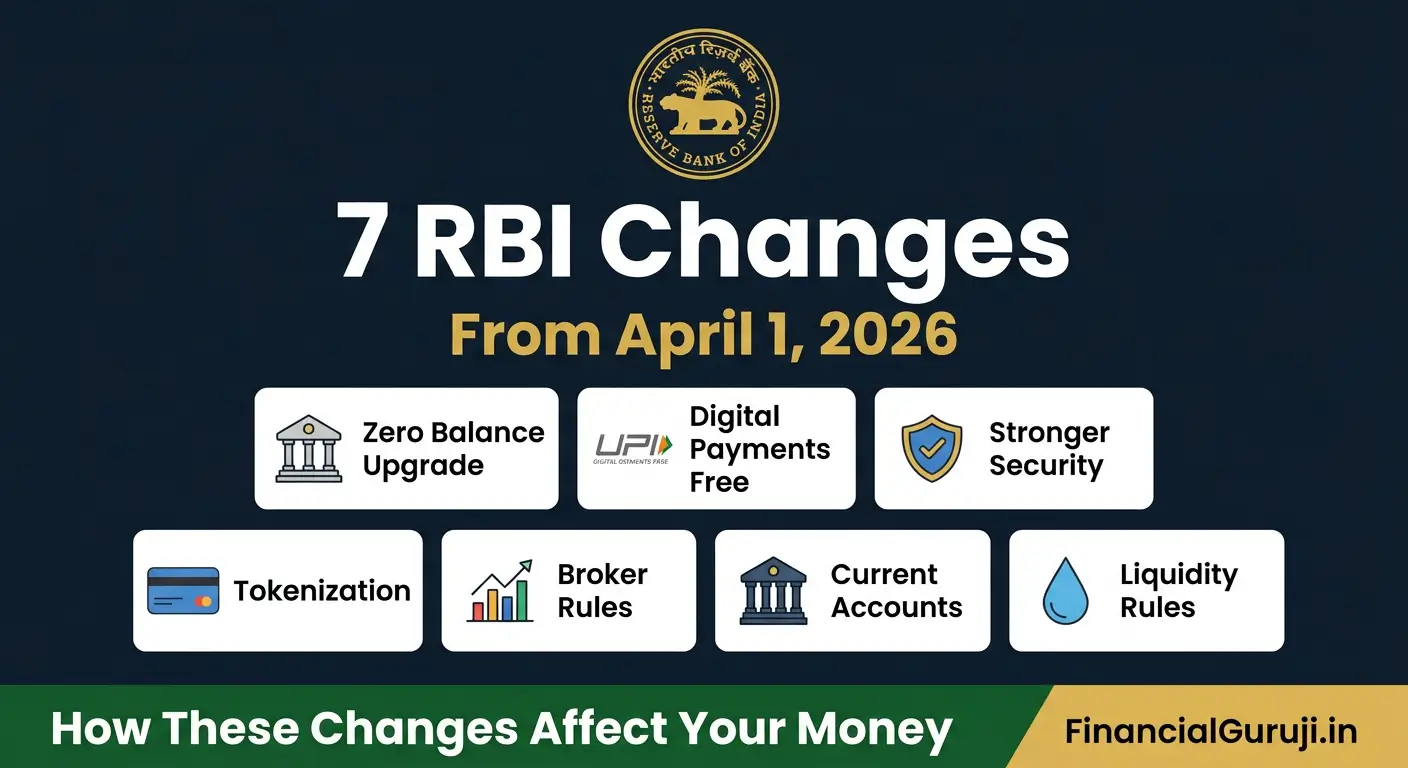
Every April 1, Indians joke about April Fool’s Day. But this year, April 1 brings something far more important — seven real changes from the Reserve Bank of India that directly affect how you bank, pay, and save.
These are not technical banking rules that only affect corporations. Several of these changes will directly impact your savings account, your UPI payments, your debit card, and your loan.
Here is everything changing from April 1, 2026 — explained simply.
Change 1 — Zero Balance Savings Account Gets a Major Upgrade
What’s changing: The RBI has completely overhauled Basic Savings Bank Deposit (BSBD) accounts — what most people know as “zero balance accounts.”
From April 1, every bank must offer BSBD accounts as a normal banking service to every customer — no minimum balance, no hidden charges, no restrictions on who can open one.
What you get free from April 1:
- Free ATM/debit card — no annual charges ever
- 25 free cheque leaves per year
- Free passbook or e-statements
- Free mobile and internet banking
- Unlimited deposits every month
- Minimum 4 free withdrawals per month including ATM
Who this helps: Anyone who currently pays annual debit card fees or minimum balance penalties. If your bank is charging you for basic services on a zero balance account — from April 1 that is not allowed.
Action: Check your savings account type. If it is a BSBD account, your bank must upgrade your services automatically by April 1 at no cost.
Change 2 — UPI and Digital Payments Will NOT Count as Withdrawals
What’s changing: Previously, some banks counted UPI, NEFT, RTGS, IMPS transactions as part of your monthly withdrawal limit on BSBD accounts.
From April 1, digital payment transactions — UPI, NEFT, RTGS, IMPS, Point of Sale — will NOT be counted as withdrawals. Only ATM and branch cash withdrawals count toward the 4 free monthly limit.
What this means for you: You can make unlimited UPI payments without worrying about hitting your free withdrawal limit. This is a significant benefit for anyone using UPI regularly for daily expenses.
Change 3 — Stronger Digital Payment Security (2-Factor Authentication Mandatory)
What’s changing: RBI’s new Authentication Framework for digital payments becomes mandatory from April 1, 2026.
Two-factor authentication is now compulsory for every digital payment transaction. But the new framework goes beyond just SMS OTP — banks can now use:
- Device fingerprinting
- Biometric verification
- Behavioral analytics (recognizes your usual payment patterns)
- Risk-based authentication — familiar devices and locations face less friction, suspicious transactions get extra checks
What this means for you: Your UPI and card payments become more secure. Unusual transactions — large amounts, new locations, new devices — may require additional verification. This is designed to reduce UPI fraud and card scams.
Important: If you get an authentication request for a transaction you did NOT initiate — reject it immediately. Tokenization and 2FA protect you only if you do not share OTPs.
Change 4 — Card Tokenization Rules Tighten Further
What’s changing: From April 1, RBI’s card tokenization compliance becomes stricter. No merchant, app, or website is allowed to store your actual card number. Only your card issuer (bank) and card network (Visa/Mastercard/RuPay) can store real card data.
What gets stored instead: a unique token — a meaningless string of numbers that only works for that specific merchant on that specific device.
What this means for you: When you save your card on Swiggy, Amazon, or Zomato — they store a token, not your actual card number. If their database is hacked, your real card number is safe.
Action: If you recently got a new debit or credit card, you may need to re-add it to apps you use. This is expected — it is not a scam.
Change 5 — Bank Lending to Stockbrokers Gets Fully Secured
What’s changing: From April 1, banks must ensure all loans given to stockbrokers, clearing members, and market intermediaries are 100% backed by collateral.
Previously, banks could give brokers flexible funding lines with partial or no collateral. Now:
- Every ₹100 lent to a broker must have ₹100 of eligible collateral
- At least 50% of collateral for bank guarantees must be in cash
- Listed shares pledged as collateral get a 40% haircut — meaning ₹100 of shares = only ₹60 of lending value
What this means for you as an investor: This is designed to prevent a broker’s bad bet from causing a banking crisis. Your money in a mutual fund or demat account is not directly affected — but the overall market becomes more stable and systemically safer.
Change 6 — Stricter Current Account Rules for Large Borrowers
What’s changing: For businesses with total loans of ₹10 crore or more, only the bank holding at least 10% of total loan exposure can operate their full current account.
Other banks can only hold a “collection account” — and all funds must be transferred to the main account within 2 working days. No withdrawals, cheques, or cards allowed on these restricted accounts.
What this means for you: If you are a salaried employee or individual investor — this change does not directly affect you. It targets large corporate borrowers to prevent fund diversion.
Change 7 — Liquidity Rules Tighten for Digital Deposits
What’s changing: Banks with large digital deposit bases face stricter liquidity buffer requirements from April 1. RBI is treating digital deposits as potentially more volatile than traditional branch deposits — meaning banks must hold more liquid assets as a buffer.
What this means for you: Banks may become slightly more conservative about interest rates on digital savings accounts. This is a background regulatory change — you will not notice it directly, but it makes the banking system safer.
Quick Summary — What Changes for You From April 1
| Change | Who It Affects | Action Needed |
|---|---|---|
| Zero balance account upgrade | Everyone with BSBD/savings account | Check if your account is upgraded |
| UPI not counted as withdrawal | BSBD account holders | No action — automatic |
| Stronger 2FA for payments | All digital payment users | Stay alert for verification requests |
| Card tokenization stricter | Anyone with saved cards on apps | Re-add cards if prompted |
| Broker lending secured | Investors, market participants | No direct action |
| Current account rules | Large businesses only | Not relevant for individuals |
| Digital deposit liquidity | Bank customers broadly | No direct action |
What You Should Do Before April 1
Check your savings account type — Log in to your bank app → Account details → See if it says “Basic Savings Bank Deposit” or “Regular Savings.” If BSBD, confirm your free services are activated.
Update your saved cards — If your debit or credit card was recently renewed or replaced, re-add it to apps like Swiggy, Amazon, Zomato before April 1 to avoid payment failures.
Enable app-based authentication — If your bank offers biometric or app-based 2FA instead of SMS OTP, switch to it. It is more secure and faster.
Key Takeaways
- April 1, 2026 brings 7 RBI rule changes affecting banking, payments and lending
- Zero balance BSBD accounts get major upgrade — free debit card, cheques, digital banking
- UPI and digital payments no longer count toward withdrawal limits
- 2-Factor authentication becomes mandatory for all digital payments
- Card tokenization tightens — your saved card is a token, not your real card number
- Bank lending to stockbrokers becomes 100% collateral-secured — market safety improves
- Most changes are automatic — check your account and update saved cards before April 1
Disclaimer: This article is for informational purposes only. For specific queries about your account, contact your bank directly. RBI guidelines apply to all scheduled commercial banks in India.