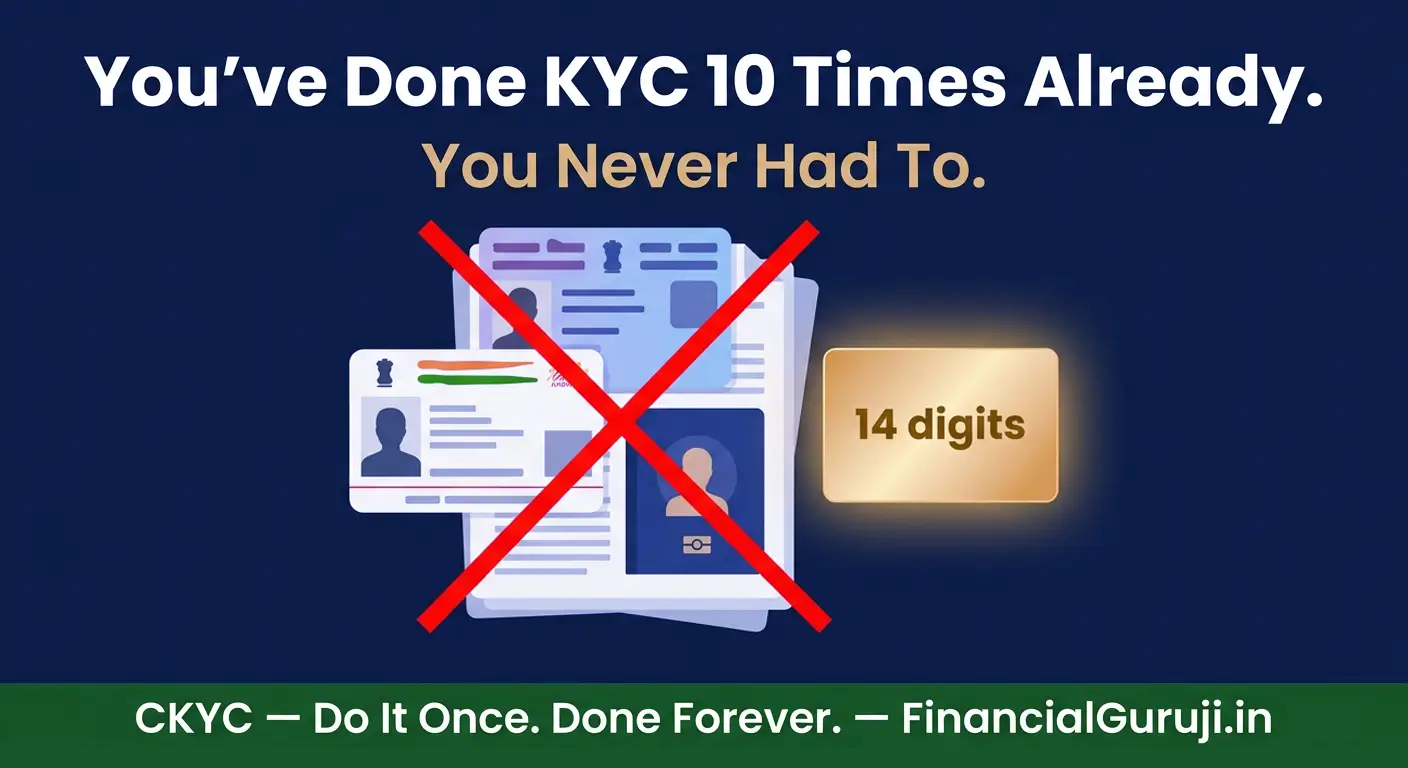
Think about how many times you have submitted the same documents.
PAN card. Aadhaar. Passport photo. Address proof. Signature.
Bank account. Mutual fund. Insurance policy. Demat account. NBFC loan. Every single time — the same stack of papers. The same verification process. The same waiting period.
What is CKYC number in India? It is a 14-digit unique code that stores all your verified KYC information in one secure government database — so you never have to submit those documents again.
RBI made CKYC the theme of Financial Literacy Week 2026. Most Indians still do not know what it is, whether they have it, or how to use it. This guide covers everything.
What Is CKYC — The Simple Explanation
CKYC stands for Central Know Your Customer.
It is a centralised database maintained by CERSAI (Central Registry of Securitisation Asset Reconstruction and Security Interest of India) — a government body under the Ministry of Finance — that stores your verified KYC information in one secure place.
Think of it as your financial identity passport — one number that works across India’s entire regulated financial system: banks, mutual funds, insurance companies, NBFCs, and stockbrokers.
The key difference between CKYC vs KYC in India:
| Regular KYC | CKYC | |
|---|---|---|
| Done at | Each institution separately | Once, stored centrally |
| Valid for | That institution only | All regulated institutions in India |
| Documents | Submitted multiple times | Submitted once |
| Update | Must update at each institution | Update once, reflects everywhere |
| Managed by | Individual banks/companies | CERSAI (Government of India) |
| Unique number | No | Yes — 14-digit KIN |
The Problem CKYC Solves
Before CKYC, opening every financial account meant submitting the same documents again and again:
- Bank account → PAN, Aadhaar, address proof, photo
- Mutual fund SIP → Same documents. Again.
- Term insurance → Same documents. Third time.
- Home loan → Fourth time.
- Demat account → Fifth time.
CKYC eliminates all of this. Do it once. Your 14-digit KYC Identification Number (KIN) works everywhere.
Do You Already Have a CKYC Number?
Probably yes — without knowing it.
If you have opened a bank account, started a SIP, or bought insurance since 2017, your institution likely uploaded your KYC to the central registry automatically.
How to check your CKYC number using PAN — three free ways:
Method 1 — Official CKYC Portal Visit ckycindia.in → Click “Fetch your CKYC Card” → Enter PAN → Verify OTP → Your 14-digit KIN appears instantly.
Method 2 — CKYC Number Check Missed Call Give a missed call to 7799022129 from your registered mobile number → Receive SMS with your CKYC details. Free, takes 30 seconds.
Method 3 — DigiLocker Login to DigiLocker → Search CKYC card → Fetch using PAN and registered mobile.
What Does the 14-Digit KIN Number Mean?
The CKYC KIN number (14-digit) is your unique KYC Identification Number. Each type starts differently:
| Type | Documents Used | KIN Starts With |
|---|---|---|
| Normal | PAN + Aadhaar/Passport/Voter ID | Numeric |
| Simplified | Other RBI-approved documents | L |
| Small | Photo only, no ID proof | S |
| OTP-based | Aadhaar PDF + OTP | O |
Most salaried individuals have the Normal type — created automatically when opening a bank account.
CKYC Registration Online — Free, Step by Step
CKYC registration is completely free. You can do it at any regulated financial institution.
Step 1 — Visit any of these: Bank branch, mutual fund office (CAMS/KFintech), insurance company branch, stockbroker, or NBFC.
Step 2 — Documents needed:
- PAN card (mandatory)
- Aadhaar or any approved ID as address proof
- One passport-size photograph
- Signature
Step 3 — Fill the CKYC form Simple form with personal details, address, and contact information.
Step 4 — In-Person Verification (IPV) Representative verifies your documents. Takes 10-15 minutes.
Step 5 — Receive your KIN Within 4-5 working days — SMS and email confirmation with your 14-digit CKYC number.
For CKYC for mutual fund investment specifically — visit CAMS (camsonline.com) or KFintech (kfintech.com) with your documents. These are the two main mutual fund registrars and can complete your CKYC directly.
How to Update CKYC — Address Change, Phone Number
CKYC address change online or at branch:
Visit any bank or regulated institution with your new address proof → Submit updated documents → Change reflects automatically across all linked institutions within 7 days.
You do NOT need to visit every bank separately. One update at one institution = updated everywhere.
Update frequency by risk category:
| Customer Risk | Re-KYC Required |
|---|---|
| Low Risk (most salaried) | Every 10 years |
| Medium Risk | Every 8 years |
| High Risk | Every 2 years |
What Happens If CKYC Is Not Done?
This is where many people face unexpected problems:
- New account opening delayed or rejected
- Mutual fund redemptions held pending verification
- Loan disbursements delayed
- Insurance claims face additional checks
- Large transactions may be restricted
RBI deadline for low-risk customers: Complete re-KYC by June 30, 2026 or within one year of original due date — whichever is later. Banks cannot freeze low-risk accounts during this grace period, but the update must happen eventually.
CKYC Frauds — Stay Alert
Fraudsters are exploiting CKYC awareness. Common scams:
- SMS or WhatsApp asking you to click a link for KYC update
- Phone calls from “bank officials” asking for OTP to complete CKYC
- Urgent emails warning your account will be frozen
The rule: Banks never ask for OTP, password, or KIN via SMS or WhatsApp. Real CKYC updates happen in person at a branch or through your bank’s official app only.
Report fraud at cybercrime.gov.in or helpline 1930.
Key Takeaways
- What is CKYC number in India: A 14-digit government-issued KIN that stores your verified KYC — do it once, valid everywhere
- You likely already have a CKYC number — check free at ckycindia.in or missed call 7799022129
- CKYC registration is free — done at any bank, mutual fund, or insurance company
- CKYC vs KYC: CKYC is central and permanent; regular KYC is institution-specific
- CKYC for mutual fund investment: Submit at CAMS or KFintech directly
- CKYC address change: One update reflects across all institutions automatically
- What happens if CKYC not done: Account restrictions, delayed loans, held redemptions
- Never share your KIN or OTP with anyone — it is a fraud
Disclaimer: This article is based on RBI guidelines and CERSAI information as of March 2026. Verify current requirements at ckycindia.in or your bank directly.