Srinivas was doing everything right. Rs 15,000 SIP every month. PPF contribution. Term insurance. Health insurance. On paper, his personal finance was in order.
Then his father had a cardiac episode in October 2023. The hospital demanded Rs 2.5 lakh upfront before the procedure. Srinivas had Rs 800 in his savings account — his entire salary had gone into investments and EMIs. He called his SIP platform to redeem. ELSS lock-in. He called his PPF — partial withdrawal rules. He called his fixed deposit — premature penalty.
He ended up borrowing from three colleagues and taking a personal loan at 14% interest. It took him 11 months to repay. His investment returns for that year were wiped out by interest payments.
The missing piece was not insurance or SIP. It was an emergency fund — money that does nothing most of the time but saves everything when you need it.
What Is an Emergency Fund — Emergency Fund Meaning India
An emergency fund is a dedicated pool of liquid cash set aside specifically for unexpected financial emergencies. It is not for planned expenses like vacations or buying a phone. It is for events you cannot predict and cannot delay: job loss, medical emergency, urgent home repair, family crisis.
The defining characteristic of an emergency fund: it must be instantly accessible. Fixed deposits with premature penalty, ELSS with lock-in, PPF with withdrawal restrictions — none of these qualify. The money must be reachable within 24 hours, ideally within minutes.
How Much Emergency Fund Do You Need
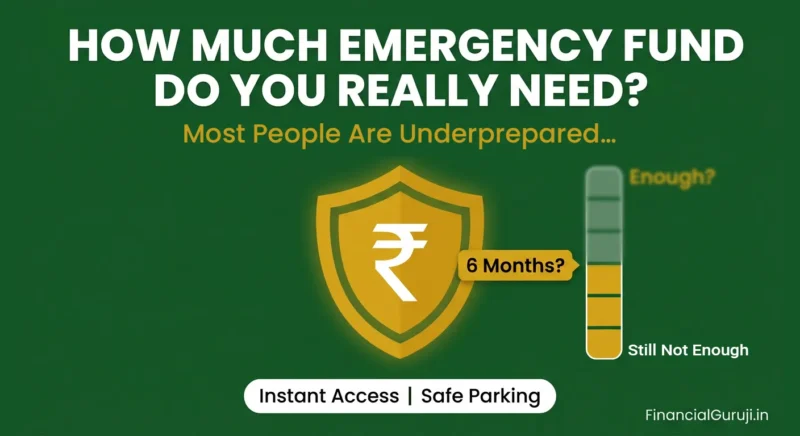
The standard recommendation is 6 months of essential monthly expenses — not 6 months of salary. There is an important difference.
| Your Situation | Recommended Emergency Fund | Reason |
| Single income household, no dependants | 3 months expenses | Lower risk — only one person to support, easier to cut costs |
| Single income, dependants (family, parents) | 6 months expenses | Higher risk — others depend on your income |
| Dual income household, stable jobs | 3-4 months expenses | One income can cover basics if other is disrupted |
| Self-employed or freelancer | 9-12 months expenses | Income is variable — larger buffer needed |
| Single income, EMI-heavy (home loan etc.) | 6-9 months expenses | EMIs continue regardless of income disruption |
| Senior citizens, retired | 12-24 months expenses | No active income source — need larger liquid buffer |
| Calculate expenses correctly: monthly rent + groceries + utility bills + EMIs + insurance premiums + school fees + medicines. Do NOT include investments, SIP, or discretionary spending in this number. If your essential monthly expenses are Rs 35,000 — your 6-month emergency fund target is Rs 2,10,000. |
Emergency Fund Size — Real Examples by Salary
| Monthly Take-Home | Essential Expenses (60%) | 6-Month Target | Build in 12 Months (Save/Month) |
| Rs 25,000 | Rs 15,000 | Rs 90,000 | Rs 7,500/month |
| Rs 40,000 | Rs 24,000 | Rs 1,44,000 | Rs 12,000/month |
| Rs 60,000 | Rs 36,000 | Rs 2,16,000 | Rs 18,000/month |
| Rs 80,000 | Rs 48,000 | Rs 2,88,000 | Rs 24,000/month |
| Rs 1,00,000 | Rs 55,000 | Rs 3,30,000 | Rs 27,500/month |
If saving that amount per month feels difficult — pause non-mandatory SIP temporarily and redirect to emergency fund. Emergency fund comes before investment. This is the correct financial priority order.
Priority Order — Emergency Fund First
| Priority | Action | Why |
| 1 — First | Term insurance + health insurance | Protect against catastrophic loss — cannot self-insure these |
| 2 — Second | Emergency fund (3-6 months expenses) | Without this, any emergency derails investments |
| 3 — Third | High-interest debt clearance (credit card 36-42%) | Guaranteed 36% return on clearing this debt |
| 4 — Fourth | Start SIP / long-term investments | Now invest with confidence — emergencies are covered |
| 5 — Fifth | Increase investments as income grows | Scale up systematically |
| Warning: Do NOT start SIP before building an emergency fund. A Rs 10,000 SIP for 2 years builds Rs 2.8 lakh. One medical emergency without an emergency fund forces you to redeem SIP, pay STCG tax, break your investment habit, and possibly take a personal loan. Start small — Rs 500 SIP + Rs 9,500 to emergency fund — until fund is built. |
Best Place to Keep Emergency Fund India 2026
The emergency fund location must satisfy three requirements: instant access, capital protection, decent return. Here are your options ranked:
| Option | Access Time | Return | Capital Safety | Verdict |
| Savings account (high yield) | Instant | 3.5-7% (varies by bank) | 100% DICGC up to Rs 5L | Good — convenience and yield |
| Liquid mutual fund | T+1 (next day) | 6.5-7.5% | Very high — no credit risk funds | Best — highest return, near-instant |
| Sweep-in FD | Instant | 6-7.5% (FD rate) | DICGC up to Rs 5L | Good — auto FD on idle balance |
| Overnight mutual fund | T+1 | 6-6.5% | Highest safety | Safe but slightly lower return |
| Bank FD (regular) | 1-3 working days | 6.5-7.5% | DICGC up to Rs 5L | Acceptable — penalty on early break |
| Savings account (regular bank) | Instant | 3-3.5% | DICGC up to Rs 5L | Easy but low return |
| Cash at home | Instant | 0% | Theft/loss risk | Avoid — only small amount |
Liquid Mutual Fund for Emergency Fund — Why It Works Best
Liquid mutual funds are the ideal emergency fund vehicle for most salaried Indians. Here is why:
- Invests only in government securities, treasury bills, and high-rated short-term instruments — near zero credit risk
- Returns: 6.5-7.5% CAGR — significantly higher than a standard savings account at 3.5%
- Access: T+1 — most platforms credit money to your bank account by the next working day. Some offer instant redemption up to Rs 50,000
- No lock-in, no penalty, no exit load for most liquid funds
- Minimum investment: Rs 500 to Rs 1,000 depending on fund
- Tax: Gains taxed at your slab rate — same as savings account interest. No LTCG advantage for short holding periods
| Top Liquid Funds for Emergency | AUM | 7-Day Yield (approx) | Min Investment |
| Nippon India Liquid Fund Direct | Rs 27,000+ Cr | 6.8-7.0% | Rs 100 |
| HDFC Liquid Fund Direct | Rs 60,000+ Cr | 6.8-7.0% | Rs 100 |
| ICICI Prudential Liquid Fund Direct | Rs 45,000+ Cr | 6.8-7.0% | Rs 500 |
| SBI Liquid Fund Direct | Rs 65,000+ Cr | 6.7-6.9% | Rs 500 |
| Axis Liquid Fund Direct | Rs 25,000+ Cr | 6.8-7.0% | Rs 500 |
| Tip: For instant access emergency needs, keep 1 month expenses in a high-yield savings account (instant access) and the remaining 5 months in a liquid mutual fund (next-day access). This two-bucket approach maximises return while keeping some funds instantly available. |
Sweep-in FD — The Underrated Option
A sweep-in fixed deposit (also called auto-sweep or flexi FD) automatically converts idle savings account balance above a threshold into an FD — and sweeps it back when you need it.
How it works: You set a threshold — say Rs 10,000. Anything above Rs 10,000 in your savings account is automatically converted into FD at FD rates (6-7.5%). When you swipe your card or transfer money, the FD breaks automatically to cover the transaction.
- Best banks for sweep-in: HDFC Bank (SmartSave), ICICI Bank (Money Multiplier), SBI (Multi Option Deposit), Kotak Bank (ActivMoney)
- Returns: FD rate of 6-7.5% on the swept portion — much better than savings account 3.5%
- Access: Completely instant — works like a normal savings account from the customer’s perspective
- Ideal for: People who find liquid fund setup complicated but want better returns than savings account
How to Build Emergency Fund — 6 Month Step Plan
Starting from zero, here is a realistic month-by-month plan:
| Month | Action | Milestone |
| Month 1 | Open dedicated high-yield savings account or liquid fund folio. Transfer 10-15% of salary. | Rs 3,000 to Rs 8,000 saved |
| Month 2 | Set up auto-transfer on salary day — before spending begins. Increase to 15-20% of salary. | Rs 9,000 to Rs 24,000 saved |
| Month 3 | Review and cut 1-2 non-essential expenses. Redirect to emergency fund. | 1 month expenses achieved |
| Month 4 | Pause lowest-priority SIP temporarily if behind target. Emergency fund is higher priority. | 2 months expenses saved |
| Month 5 | Keep momentum — auto-transfer makes this effortless by now. | 3-4 months expenses saved |
| Month 6 | Target achieved — 6 months expenses in liquid account. Restart any paused SIP. Do not touch fund. | Full emergency fund built |
| The most important rule after building the emergency fund: replenish it immediately after use. If you use Rs 80,000 from your emergency fund for a medical bill, that becomes your first financial priority after the emergency — refill before resuming SIP or any other investment. |
Emergency Fund vs Investment — Common Questions
| Question | Answer |
| Should I invest emergency fund in stocks for higher return? | No. Emergency fund must be capital-safe. A 20% market crash that happens the same week as your emergency leaves you with 20% less money exactly when you need it most. |
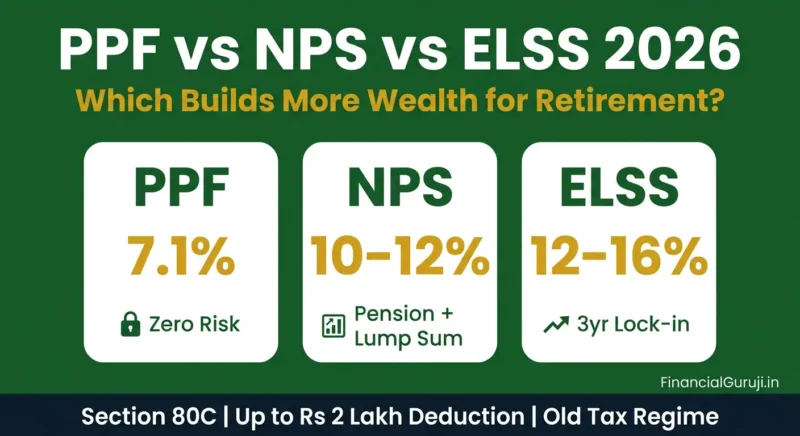
| Can I use my PPF balance as emergency fund? | No — PPF partial withdrawal only from year 7, and full withdrawal only at 15-year maturity. It is not accessible when you need it urgently. |
| Should emergency fund be separate from salary account? | Yes — keep it in a separate account. Mixing emergency fund with daily spending leads to slow erosion of the balance. Out of sight = out of spending reach. |
| Does everyone need 6 months? What about 3 months? | 3 months is minimum. 6 months is standard. If you have a very stable government job with job security, 3 months may suffice. Private sector salaried employees should target 6 months. |
Use our SIP Calculator to plan how to rebuild your emergency fund target — and how long it takes at different monthly saving rates
Frequently Asked Questions
How much emergency fund should I have in India 2026?
The standard recommendation is 6 months of essential monthly expenses — rent, EMIs, groceries, utilities, insurance premiums. Not 6 months of salary. If your essential expenses are Rs 30,000 per month, your target emergency fund is Rs 1,80,000. Self-employed individuals and people with dependants should target 9-12 months of expenses.
Where should I keep my emergency fund in India?
Best options in order: liquid mutual fund (6.5-7.5% return, T+1 access), sweep-in FD (FD rates, instant access), or high-yield savings account like Equitas, AU Small Finance, or IDFC First (5-7% on savings). Avoid keeping emergency fund in equity mutual funds, stocks, PPF, or ELSS — these either carry market risk or have withdrawal restrictions.
Should I build emergency fund or start SIP first?
Emergency fund first. Without it, any financial shock forces you to break SIP, pay premature withdrawal penalties, and potentially take high-interest debt. Build at least 3 months of expenses as emergency fund before starting SIP. Then start SIP. Then grow emergency fund to 6 months while running SIP simultaneously.
Can I keep emergency fund in a liquid mutual fund?
Yes — liquid funds are one of the best emergency fund vehicles in India. They offer 6.5-7.5% returns, next-day redemption, no lock-in, and very high capital safety. Most platforms like Groww and Kuvera offer instant redemption up to Rs 50,000. For amounts above Rs 50,000, redemption takes 1 working day. Keep 1 month expenses in savings account for truly immediate needs.
What counts as a real emergency for emergency fund use?
Real emergencies: job loss and income gap, medical emergency not covered by insurance, urgent home repair (roof leak, water damage), family crisis requiring immediate travel or support, car breakdown essential for work commute. Not emergencies: sale offers, gadget upgrades, vacations, weddings (planned events should have separate savings). The test: could this wait 3 months? If yes, it is not an emergency.
I used my emergency fund. Now what?
Immediately after the emergency is resolved, start rebuilding. Pause non-essential SIP temporarily and redirect to replenishing the emergency fund. Set a target date to restore it fully — typically 3-6 months. Treat the replenishment as your highest financial priority until the fund is back to its original level.