
Preethi moved to Bengaluru six years ago for her IT job. She pays Rs 28,000 a month in rent for a 2BHK in Whitefield — and has been paying it for years.
Every year, when she calculates her HRA exemption, the same frustration comes up. Bengaluru rents are as expensive as Delhi or Mumbai. But for tax purposes, Bengaluru was treated like a Tier 2 city — which means her HRA exemption was capped at 40% of basic salary, not 50%.
From April 2026, that changes.
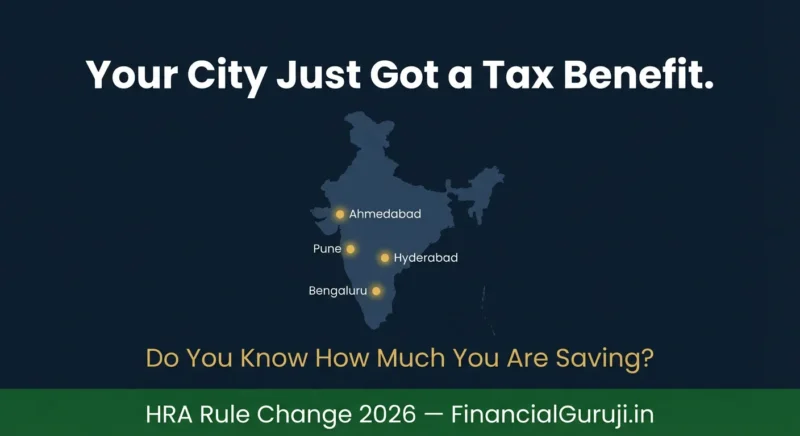
The Income Tax Rules 2026 officially added Bengaluru, Hyderabad, Pune, and Ahmedabad to the list of metro cities for HRA calculation. If you live in any of these cities, pay rent, and claim HRA — you just got a meaningful tax upgrade.
But there is a catch. The new rules also made compliance stricter. Miss a step, and you lose the exemption entirely.
Let us break down everything — how much you save, how to calculate it, and what the new rules require from you.
First — What Is HRA Exemption and How Does It Work?
If your company gives you House Rent Allowance as part of your salary and you actually pay rent — you can claim a portion of that HRA as tax-exempt. This means it is not counted as your income and you do not pay tax on it.
But the exemption is not simply ‘your full HRA is tax free.’ The government uses a formula called the ‘least of three’ rule. Your HRA exemption is the lowest of these three amounts:
- Actual HRA received from employer
- Rent paid minus 10% of your basic salary
- 50% of basic salary (if in metro city) or 40% of basic salary (if in non-metro city)
The third condition is where the April 2026 change matters. Until March 2026, only Delhi, Mumbai, Kolkata, and Chennai were treated as metro cities for this calculation. Everyone else — including Bengaluru and Hyderabad — was capped at 40%.
From April 2026, eight cities qualify for 50%:
📊 Cities Eligible for 50% HRA Exemption — Before vs After April 2026
| City | Before April 2026 | From April 2026 |
| Delhi | 50% (Metro) | 50% (Metro) |
| Mumbai | 50% (Metro) | 50% (Metro) |
| Kolkata | 50% (Metro) | 50% (Metro) |
| Chennai | 50% (Metro) | 50% (Metro) |
| Bengaluru | 40% (Non-Metro) | 50% (Metro) ✅ NEW |
| Hyderabad | 40% (Non-Metro) | 50% (Metro) ✅ NEW |
| Pune | 40% (Non-Metro) | 50% (Metro) ✅ NEW |
| Ahmedabad | 40% (Non-Metro) | 50% (Metro) ✅ NEW |
| All other cities | 40% | 40% (no change) |
| Noida / Gurugram | 40% | 40% (no change) |
Important: This upgrade applies only if you are on the old tax regime. If you have opted for the new tax regime, HRA exemption is not available regardless of which city you live in.
How Much Extra Tax Do You Save? Real Calculation
Let us take two real-world examples to show you exactly what this 10% increase means for your wallet.
Example 1 — Preethi, IT Professional, Bengaluru
Basic salary: Rs 60,000/month | HRA received: Rs 24,000/month | Rent paid: Rs 28,000/month | Old tax regime
📊 Preethi’s HRA Exemption — Before vs After April 2026
| Before April 2026 (40%) | After April 2026 (50%) | |
| Condition 1: Actual HRA received | Rs 2,88,000/year | Rs 2,88,000/year |
| Condition 2: Rent paid minus 10% of basic | Rs 2,64,000/year | Rs 2,64,000/year |
| Condition 3: % of basic salary | 40% = Rs 2,88,000/year | 50% = Rs 3,60,000/year |
| HRA Exemption (LOWEST of 3) | Rs 2,64,000/year | Rs 2,64,000/year |
| Tax saved (30% bracket) | Same | Same — no change here |
Why No Change for Preethi? Condition 2 (rent minus 10% of basic) is still the lowest at Rs 2,64,000. The city upgrade to 50% only helps when Condition 3 would otherwise be the binding constraint. Preethi needs to pay higher rent or have a higher basic for the change to matter.
Example 2 — Arjun, Senior Manager, Hyderabad
Basic salary: Rs 1,20,000/month | HRA received: Rs 60,000/month | Rent paid: Rs 50,000/month | Old tax regime
📊 Arjun’s HRA Exemption — Before vs After April 2026
| Before April 2026 (40%) | After April 2026 (50%) | |
| Condition 1: Actual HRA received | Rs 7,20,000/year | Rs 7,20,000/year |
| Condition 2: Rent paid minus 10% of basic | Rs 4,56,000/year | Rs 4,56,000/year |
| Condition 3: % of basic salary | 40% = Rs 5,76,000/year | 50% = Rs 7,20,000/year |
| HRA Exemption (LOWEST of 3) | Rs 4,56,000/year | Rs 4,56,000/year |
| Tax saved (30% bracket) | Rs 1,36,800/year | Same — Condition 2 still wins |
Key Insight: In most practical cases, Condition 2 (actual rent minus 10% of salary) is the binding constraint — not the city percentage. The 50% upgrade directly benefits you only when Condition 3 is the lowest, which typically happens when your HRA component is large, your basic salary is high, and your rent paid is relatively lower.
Example 3 — Kavitha, Where the Change REALLY Helps
Basic salary: Rs 1,50,000/month | HRA received: Rs 75,000/month | Rent paid: Rs 55,000/month | Old tax regime | Lives in Pune
📊 Kavitha’s HRA Exemption — This Is Where 50% Makes a Difference
| Before April 2026 (40%) | After April 2026 (50%) | |
| Condition 1: Actual HRA received | Rs 9,00,000/year | Rs 9,00,000/year |
| Condition 2: Rent paid minus 10% of basic | Rs 4,80,000/year | Rs 4,80,000/year |
| Condition 3: % of basic salary | 40% = Rs 7,20,000/year | 50% = Rs 9,00,000/year |
| HRA Exemption (LOWEST of 3) | Rs 4,80,000/year | Rs 4,80,000/year |
| Tax saved (30% bracket) | Rs 1,44,000/year | Same — Condition 2 still wins |
You will notice that in most scenarios, Condition 2 wins. The 50% upgrade helps specifically when someone has a very structured CTC with a large basic component and moderate actual rent. This is more common in senior roles, PSU employees, and government employees.
The practical bottom line: if you live in Bengaluru, Hyderabad, Pune, or Ahmedabad and your basic salary is above Rs 1.5 lakh per month, run the calculation — you could be saving Rs 20,000 to Rs 60,000 extra annually.
The New Compliance Rules — This Is Where Most People Will Trip Up
Here is the uncomfortable truth about HRA 2026: the government gave you a potential extra benefit with one hand, and made the compliance rules much stricter with the other.
Under the old rules, claiming HRA was relatively relaxed. You submitted rent receipts to HR, maybe a landlord declaration, and you were done. From April 2026, the Income Tax Department is taking a sharper look at HRA claims — especially fake rent receipts and circular payments to family members.
What the New Rules Require
📊 HRA Compliance Checklist — New Rules from April 2026
| Requirement | Old Rule | New Rule (April 2026) |
| Rent receipts | Required | Required + must be genuine |
| Landlord PAN | Required if rent > Rs 1 lakh/year | Required if rent > Rs 1 lakh/year (strictly enforced) |
| Relationship disclosure | Not required | Mandatory — must declare if landlord is family member |
| Investment declaration form | Form 12BB | New Form 124 |
| Digital payment proof | Optional | Strongly recommended |
| Rental agreement | Optional | Strongly recommended |
| Landlord’s ITR | Not checked | Cross-referenced via AIS |
The Family Landlord Situation — Read This Carefully
Many salaried Indians pay rent to their parents to claim HRA. This is perfectly legal — as long as it is done correctly.
From April 2026, if your landlord is a family member (parents, spouse, or siblings), you must declare this relationship in Form 124. The Income Tax Department will then cross-check whether your parents have declared that rental income in their own ITR.
If they have not — both your HRA claim and their income reporting will face scrutiny.
The practical steps if you are paying rent to parents:
- Have a proper rent agreement in place — even if informal, make it written
- Pay rent via bank transfer every month — not cash
- Make sure parents show this rental income in their ITR
- Declare the relationship in your Form 124 investment declaration
- Keep rent receipts signed by parents with their PAN mentioned
Fake rent receipts — where no rent is actually paid and receipts are just created on paper — are now being flagged through AI-driven data matching between employer-reported HRA and actual bank transactions. The risk of getting caught has increased significantly.
Should You Switch to Old Regime Because of This?
This is the question most people in Bengaluru and Hyderabad are now asking.
The honest answer: it depends on your numbers.
The old regime has become more attractive in 2026 — the HRA upgrade, the increased children’s education allowance, and higher meal card exemptions all push in that direction. But the new tax regime still wins for people with fewer deductions.
Here is a quick way to decide:
📊 Old Regime vs New Regime — Who Should Consider Which in 2026
| Your Situation | Likely Better Option |
| Pay high rent in Bengaluru/Hyderabad/Pune/Ahmedabad | Old Regime |
| Have school-going children + pay rent | Old Regime — dual benefit |
| Have home loan + HRA + 80C investments | Old Regime |
| Income under Rs 12 lakh, no major deductions | New Regime |
| Freelancer/consultant, simple income | New Regime |
| New employee, first job, no rent payment | New Regime |
The best approach: ask your CA or use an online tax calculator to run both scenarios with your actual numbers. Do not assume — calculate.
One Thing Many People Miss — The Filing Year Transition
Here is something important that most articles are not mentioning clearly.
The 50% HRA upgrade applies from Tax Year 2026-27 — meaning income earned from April 1, 2026 onwards.
When you file your ITR in July 2026, you are filing for FY 2025-26 (Tax Year 2025-26). The old 40% rule still applies for that filing, even if you live in Bengaluru or Hyderabad.
The new 50% benefit will appear in your ITR filing in July 2027 — for Tax Year 2026-27.
So the actual tax saving hits your pocket in 2027, not this July.
What to Do Right Now — 5 Action Steps
- Check your city — if you are in Bengaluru, Hyderabad, Pune, or Ahmedabad, you qualify for the upgrade
- Verify your tax regime — the HRA benefit only applies in the old regime. If you are on the new regime, recalculate whether switching makes sense
- Run the calculation — use the ‘least of three’ formula with your actual basic salary and rent to see if the 50% cap actually helps you
- Update Form 124 with your employer — this replaces the old Form 12BB. Submit your HRA declaration including landlord PAN and relationship (if applicable)
- If paying rent to parents — ensure they have declared the rental income in their ITR. This is now mandatory for smooth claim processing
Key Takeaways
- HRA exemption 50 percent Bengaluru Hyderabad Pune Ahmedabad — all four cities added to metro list from April 2026
- Old 4-city list (Delhi, Mumbai, Kolkata, Chennai) now becomes 8-city list
- 50% benefit applies only under the old tax regime — new regime has no HRA exemption
- In most practical cases, Condition 2 (rent minus 10% of basic) is the binding constraint — the 50% upgrade directly helps only when basic salary is high and rent relative to basic is moderate
- New compliance rules from April 2026: Form 124 replaces Form 12BB, relationship with landlord must be declared, landlord PAN mandatory if rent exceeds Rs 1 lakh annually
- Family landlord arrangement (paying rent to parents) is legal but now requires mandatory relationship disclosure and cross-verification of parents’ ITR
- The actual filing benefit appears in July 2027 ITR — not July 2026
- Noida and Gurugram still at 40% — not included in the expansion
Disclaimer: This article is based on Income Tax Rules 2026 effective April 1, 2026. HRA exemption calculations depend on individual salary structure. Consult your employer HR or a tax professional before making regime decisions.