Every year around January, the same question floods WhatsApp groups, office canteens, and family chats — “Which tax regime should I pick this year?”
And every year, millions of salaried employees either guess, copy their colleague’s choice, or just go with whatever their company’s payroll portal defaulted to. Most of them leave ₹10,000 to ₹50,000 on the table — money that could have stayed in their pocket with 15 minutes of calculation.
The government introduced the new tax regime in FY 2020-21, overhauled it completely in FY 2023-24 with new income tax slabs, and made further tweaks for FY 2025-26. By now the two regimes are genuinely different products — and which one wins depends entirely on your salary, your deductions, and your life situation.
Let me break it down completely — income tax slabs, real examples, and a clear decision framework.
The Core Difference in One Line
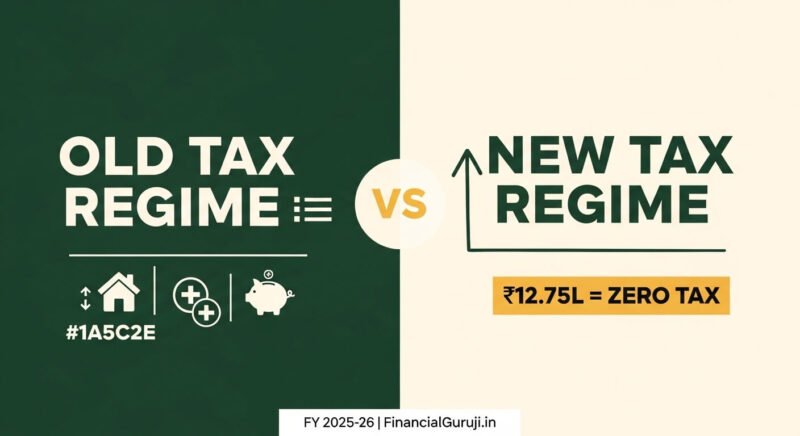
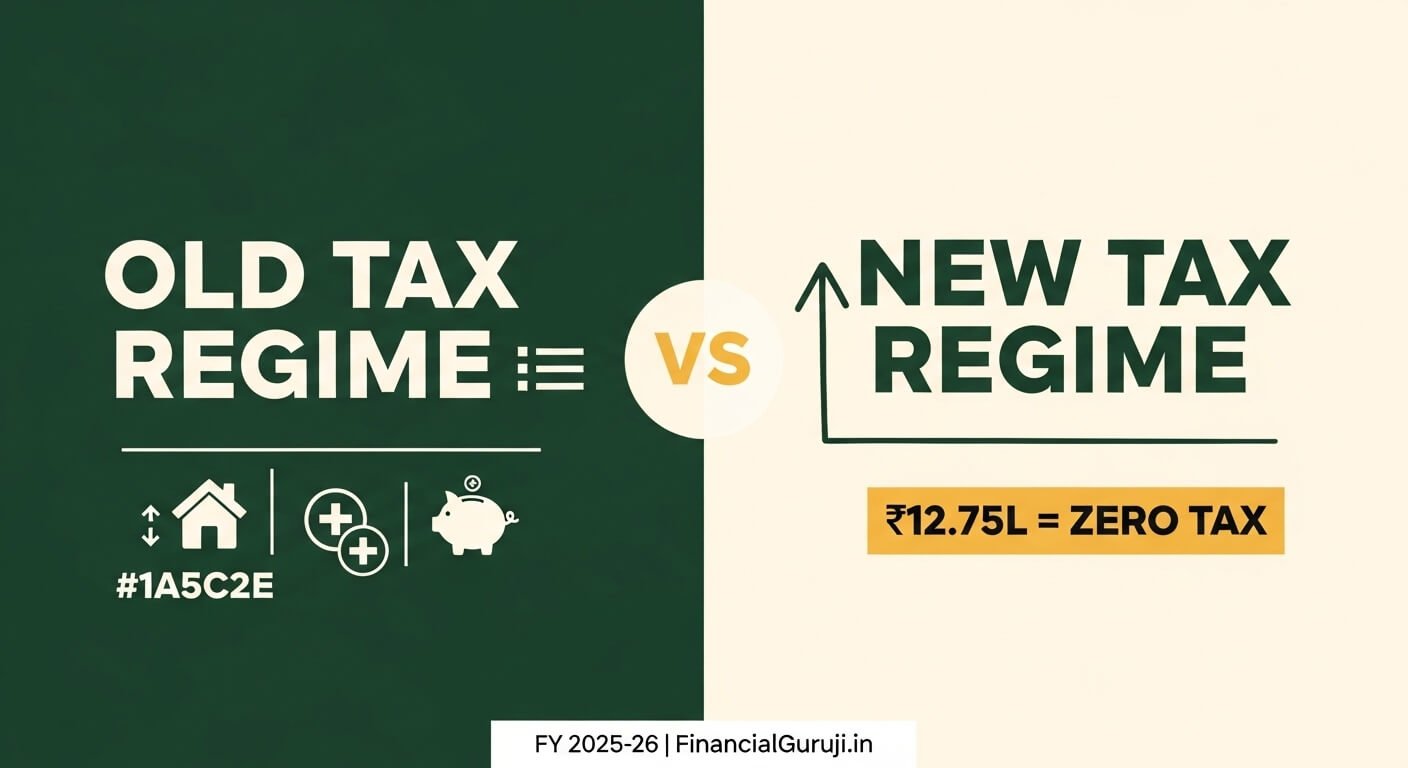
Old regime: higher tax rates, but lets you claim many deductions. New regime: lower tax rates, but almost no deductions allowed.
Old Tax Regime — Income Tax Slabs 2025-26
The old regime has been the default system for decades. It taxes your income at higher slab rates but gives you a long list of deductions to reduce your taxable income before applying those rates.
| Income Slab | Tax Rate (Old Regime) |
| Up to ₹2.5 lakh | Nil |
| ₹2.5 lakh – ₹5 lakh | 5% |
| ₹5 lakh – ₹10 lakh | 20% |
| Above ₹10 lakh | 30% |
Key deductions available in old regime: 80C (up to ₹1.5 lakh), HRA exemption, home loan interest under Section 24b (up to ₹2 lakh), health insurance under 80D (up to ₹25,000), NPS under 80CCD(1B) (extra ₹50,000), and more. The 80C deduction limit alone covers PPF, ELSS, EPF, LIC premiums, and home loan principal.
New Tax Regime — Income Tax Slabs 2025-26
The new regime was redesigned from the ground up for FY 2023-24 and carries forward into FY 2025-26 with one major addition — the standard deduction of ₹75,000 for salaried employees (up from ₹50,000). The income tax slabs are lower, but most deductions are gone.
| Income Slab | Tax Rate (New Regime) |
| Up to ₹3 lakh | Nil |
| ₹3 lakh – ₹7 lakh | 5% |
| ₹7 lakh – ₹10 lakh | 10% |
| ₹10 lakh – ₹12 lakh | 15% |
| ₹12 lakh – ₹15 lakh | 20% |
| Above ₹15 lakh | 30% |
Big win in new regime: The Section 87A rebate means income up to ₹12 lakh has zero tax liability under the new regime. For salaried employees, add the ₹75,000 standard deduction 2025 — making the effective zero-tax income limit ₹12.75 lakh. This is a genuine game-changer for middle-income earners.
The Simple Decision Rule
| New regime wins when your deductions are LOW. Old regime wins when your deductions are HIGH. The crossover point for most salaried people is around ₹3.75 lakh in total annual deductions. |
To decide, add up your real deductions for FY 2025-26:
- 80C investments — PPF, ELSS, EPF employee contribution, LIC premium, home loan principal (max ₹1.5 lakh, this is the 80C deduction limit)
- HRA exemption — if you pay rent and receive HRA in your salary
- Home loan interest under Section 24b — up to ₹2 lakh
- Health insurance premium under 80D — up to ₹25,000 (₹50,000 if parents are senior citizens)
- NPS contribution under 80CCD(1B) — extra ₹50,000 beyond 80C
If your total deductions exceed ₹3.75 lakh → old regime likely saves more. Below ₹3.75 lakh → new regime almost always wins.
Real Salary Examples — Calculated Properly
Example 1 — ₹8 Lakh Salary, Minimal Deductions (Fresher / Work From Home)
This person has basic 80C of ₹50,000 (EPF auto-deducted). No HRA (WFH), no home loan.
| Old Regime | New Regime | |
| Gross salary | ₹8,00,000 | ₹8,00,000 |
| Standard deduction | ₹50,000 | ₹75,000 |
| 80C deduction | ₹50,000 | Not allowed |
| Taxable income | ₹7,00,000 | ₹7,25,000 |
| Income tax payable | ₹52,500 | ₹22,500 |
| Savings vs other | — | Saves ₹30,000 more |
New regime wins by ₹30,000 here. This is the most common scenario for young IT employees and WFH professionals.
Example 2 — ₹12 Lakh Salary, Heavy Deductions (Metro City, Home Loan)
This person pays ₹20,000/month rent in Hyderabad, has a home loan with ₹1.8 lakh annual interest, maxes 80C, pays health insurance, and contributes to NPS.
| Deduction | Old Regime Amount | New Regime |
| Standard deduction | ₹50,000 | ₹75,000 |
| 80C (EPF+ELSS+LIC) | ₹1,50,000 | Not allowed |
| HRA exemption | ₹1,44,000 | Not allowed |
| Home loan interest 24b | ₹1,80,000 | Not allowed |
| 80D health insurance | ₹25,000 | Not allowed |
| NPS 80CCD(1B) | ₹50,000 | Not allowed |
| Total deductions | ₹5,99,000 | ₹75,000 |
| Taxable income | ₹6,01,000 | ₹11,25,000 |
| Tax payable | ₹32,700 | ₹86,250 |
| WINNER | Old regime saves ₹53,550 |
Old regime wins massively here. For anyone with a home loan + HRA + full 80C, the old regime is almost always the right choice in FY 2025-26.
Example 3 — ₹15 Lakh Salary, Moderate Deductions
This is the gray zone. With moderate deductions (80C only, no home loan, basic 80D), the difference narrows significantly. Use the income tax calculator on this site to plug in your exact numbers — the gap could go either way by ₹5,000 to ₹20,000.
What Deductions Are Allowed in the New Regime?
This is the most asked question during ITR filing 2025 season. The new regime is NOT completely deduction-free — here’s what you still get:
| Deduction / Exemption | Allowed in New Regime? |
| Standard deduction ₹75,000 (salaried) | ✅ Yes — standard deduction 2025 |
| NPS employer contribution 80CCD(2) | ✅ Yes — up to 10% of salary |
| Agniveer Corpus Fund 80CCH | ✅ Yes |
| HRA exemption | ❌ No |
| Home loan interest Section 24b | ❌ No (self-occupied) |
| 80C — PPF, ELSS, LIC, EPF | ❌ No |
| 80D — health insurance premium | ❌ No |
| NPS employee contribution 80CCD(1B) | ❌ No |
| LTA — Leave Travel Allowance | ❌ No |
TDS and How Regime Choice Affects Your Monthly Salary
Your employer deducts TDS (Tax Deducted at Source) from your salary every month based on your declared tax regime. Since FY 2023-24, the new regime is the default for TDS deduction.
If you don’t declare your regime choice to HR before April — your employer will deduct TDS under the new regime automatically. If the old regime saves you more, you’ll need to either declare it to your employer in April, or claim a refund when filing ITR 2025.
Tip: Declare your regime choice to HR in the first week of April every year. Don’t wait until March to start tax planning India — by then it’s too late to invest in 80C or NPS for that financial year.
New Regime as Default — What This Means for You
From FY 2023-24 onwards, the new regime is the default. If you do nothing — you’re in the new regime. To switch to old regime you must actively opt in, either by declaring to your employer or by selecting it when filing your ITR.
For ITR filing 2025 (FY 2025-26 returns filed in July-September 2026): Salaried employees can switch regimes every year. Business owners and professionals have more restricted switching — they can switch from new to old only once.
Who Should Definitely Choose New Regime in 2025-26
- Freshers and first-job employees — EPF just started, no home loan, no HRA
- Work-from-home employees in tier-2 or tier-3 cities — no HRA benefit
- Anyone earning under ₹12.75 lakh — zero tax income 2025-26, no deductions needed
- People who don’t invest in 80C instruments or prefer flexibility in investments
- Employees whose company default is new regime and TDS is already low — switching would mean refund delays
Who Should Stick with Old Regime in 2025-26
- Metro city employees paying ₹15,000+ monthly rent and receiving HRA
- Home loan borrowers paying ₹1.5 lakh+ in annual interest
- Anyone who consistently maxes 80C + NPS 80CCD(1B) every year
- Salaried people with income above ₹15 lakh and multiple deductions
- Parents paying for children’s education in private schools (80C includes tuition fees)
The One Calculation That Settles It
Open the Income Tax Calculator on this site. Enter:
- Your CTC or gross salary
- Your actual HRA received and rent paid
- Your 80C investments this year
- Home loan interest if any
- Health insurance premium
The calculator shows tax under both regimes side by side. That number tells you exactly which regime to pick — no guessing, no generic advice needed. This 5-minute calculation could save you ₹20,000 to ₹80,000 this financial year.
Quick Summary Table
| Factor | New Regime | Old Regime |
| Income tax slabs 2025-26 | Lower rates | Higher rates |
| Standard deduction 2025 | ₹75,000 ✅ | ₹50,000 ✅ |
| 80C deduction limit | ❌ Not available | ₹1.5 lakh ✅ |
| HRA exemption | ❌ Not available | ✅ Available |
| Section 24b home loan | ❌ Not available | ₹2 lakh ✅ |
| Zero tax income 2025-26 | Up to ₹12.75 lakh | Up to ₹5 lakh |
| Best for | Low/no deductions | High deductions |
| Default for TDS? | ✅ Yes (since 2023-24) | No — must opt in |
| ITR filing flexibility | Can switch yearly | Can switch yearly |
My honest view: For most salaried employees under ₹12.75 lakh with average savings habits, the new regime is the clear winner in FY 2025-26. For home loan borrowers and metro city renters who claim ₹4 lakh+ in deductions, the old regime still saves significantly more. Do the math — it takes 5 minutes and the answer is clear.
→ Use our free Income Tax Calculator to compare both regimes with your exact salary and deductions
Frequently Asked Questions
Can I switch between old and new tax regime every year?
Yes — salaried employees can switch regimes every financial year. You can declare your choice to your employer at the start of the year, or choose while filing ITR. Business owners can switch from new to old regime only once.
Is the new tax regime the default for TDS deduction in 2025-26?
Yes. Since FY 2023-24, the new regime is the default. Your employer will deduct TDS under the new regime unless you explicitly opt for the old regime in writing. Declare your regime choice to HR in April to avoid surprises.
What is the Section 87A rebate in new regime for FY 2025-26?
Under the new regime, taxpayers with net taxable income up to ₹12 lakh get a full tax rebate under Section 87A — effectively paying zero tax. For salaried people, adding the ₹75,000 standard deduction takes this zero-tax limit to ₹12.75 lakh.
What deductions are allowed in the new tax regime in 2025-26?
Very few. The main ones are: standard deduction of ₹75,000 for salaried employees, NPS employer contribution under 80CCD(2), and Agniveer corpus fund under 80CCH. Most popular deductions — HRA, 80C, home loan interest, 80D — are NOT allowed.
Which regime is better for a ₹10 lakh salary?
It depends on your deductions. With minimal deductions, new regime saves more due to lower income tax slabs 2025-26 and the ₹75,000 standard deduction. If you pay rent, have a home loan, or max out 80C, calculate both — old regime may still win. Use our income tax calculator to check your exact situation.
I forgot to declare my regime to my employer. What do I do?
Your employer defaulted to new regime and deducted TDS accordingly. You can still claim old regime benefits when filing your ITR 2025. If old regime saves you more, you’ll get a refund — but it’ll come after you file your return (typically August–October 2026 onwards).