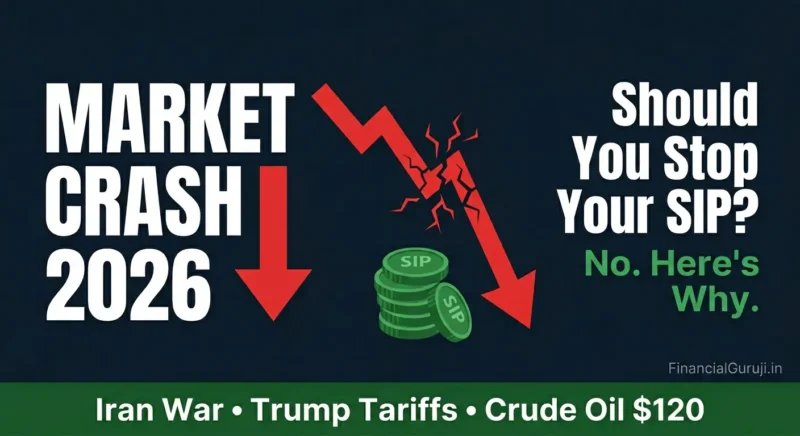
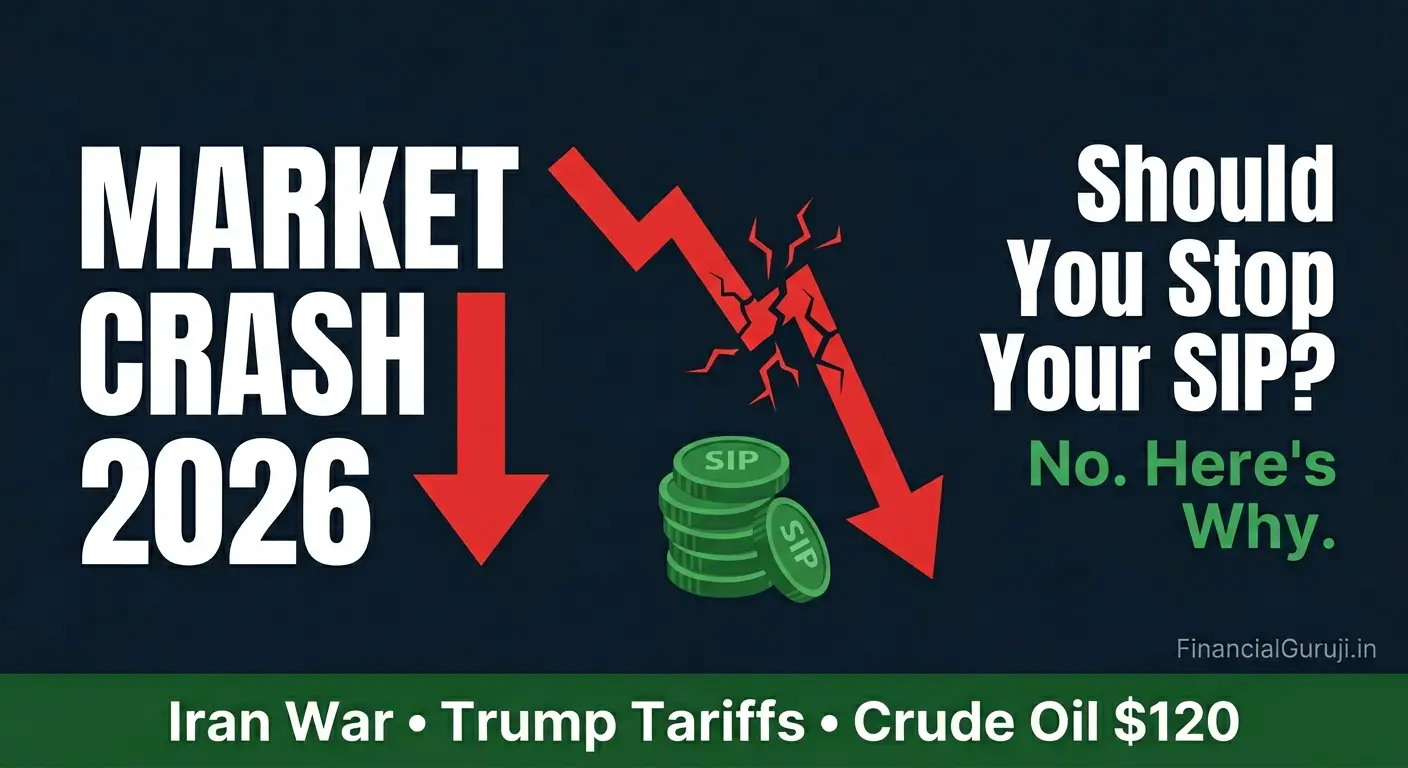
Should I stop my SIP during market crash — this is the one question every salaried investor is asking this week.
If you checked your portfolio this week, you probably felt it — that sinking feeling when you see your SIP investments down 7%, 10%, or more. Your Nifty 50 holdings have lost value. The Sensex has crashed thousands of points. WhatsApp groups are full of panic.
Before you do anything with your investments, read this completely.
What Is Actually Happening Right Now
The Indian stock market is under pressure from three simultaneous forces — and understanding each one is important before making any decision.
1. The US-Iran War and the Strait of Hormuz
On February 28, 2026, US and Israeli forces launched strikes on Iran in what became a full-scale military conflict. Iran responded by closing the Strait of Hormuz — a narrow waterway through which 20% of the world’s oil supply passes every single day.
For India, this is not a distant geopolitical event. It hits us directly:
- India imports 85% of its crude oil requirement — 4.2 million barrels every day
- Of that, 50% normally transits through the Strait of Hormuz
- Crude oil prices have surged from $67 to over $108 per barrel — a 61% spike in days
- Brent crude has crossed $120 per barrel at the peak
The result: fuel costs rise, inflation rises, corporate profits shrink, and investors panic.
2. Trump Tariffs — The Second Hit
Even before the war, Indian markets were already under pressure. The Trump administration has launched trade investigations against 16 economies under Section 301 of the 1974 Trade Act — targeting countries it believes have unfair trade practices.
India is directly in the crosshairs. Higher tariffs on Indian exports mean lower revenues for Indian IT, pharma, and manufacturing companies that depend on US clients. That hits their stock prices.
3. FPI Selling — ₹32,800 Crore Gone in Days
Foreign Portfolio Investors — the large global funds that invest in Indian markets — have been pulling money out aggressively.
In just the past few trading sessions, FPIs sold Indian equities worth over ₹32,800 crore. When this much money exits simultaneously, markets fall sharply regardless of how strong India’s fundamentals are.
The combined result: Sensex fell over 2,500 points in a single session on March 9. Nifty 50 is down approximately 7% in 10 days. India VIX — the fear index — surged 73% year-to-date. Investor wealth of ₹25 lakh crore wiped out on paper in days.
Why This Feels Worse Than It Is
Here is what the news headlines will not tell you.
Every single major market crisis in history — every one — eventually recovered. And long-term investors who stayed invested came out ahead of those who panicked and exited.
| Crisis | Nifty Fall | Recovery Time |
|---|---|---|
| 2008 Global Financial Crisis | -60% | 18 months |
| 2020 COVID Crash | -38% in 40 days | 6 months |
| 2016 Demonetisation | -15% | 3 months |
| 2022 Russia-Ukraine War | -12% | 4 months |
| 2026 Iran War + Tariffs | ~7-10% so far | ? |
Notice something? Every crisis recovered. The investors who panicked and sold at the bottom locked in their losses permanently. The investors who stayed — or better, invested more — recovered and grew.
What This Means for Your SIP
This is the most important section if you are a salaried investor with a monthly SIP.
Your SIP is designed exactly for this moment.
When markets fall, your fixed SIP amount buys more units at lower prices. This is called rupee cost averaging — and it is the entire reason SIP was designed the way it is.
A simple example:
| Month | NAV | SIP Amount | Units Bought |
|---|---|---|---|
| January | ₹100 | ₹5,000 | 50 units |
| February | ₹90 | ₹5,000 | 55.5 units |
| March (crash) | ₹75 | ₹5,000 | 66.6 units |
In March, your ₹5,000 bought 33% more units than in January — at no extra cost to you. When markets recover, those extra units mean extra profits.
Stopping your SIP during a crash is the worst possible decision. You are giving up the exact advantage that SIP was built to give you.
What Should You Actually Do Right Now
If You Have an Existing SIP
Do nothing. Continue as normal.
Do not pause. Do not reduce the amount. Do not switch to a debt fund out of panic. Your SIP is already working in your favour — more units at lower prices every month the market stays down.
If You Have a Lumpsum Amount Sitting Idle
This is actually a rare opportunity.
Markets are down 7-10%. Quality companies — HDFC Bank, Infosys, Asian Paints, Reliance — are available at prices you could not get six months ago.
If you have a lumpsum and a 3+ year horizon, consider investing it in a Nifty 50 index fund in 3-4 installments over the next 2-3 months rather than all at once. This protects you if markets fall further while ensuring you do not miss the eventual recovery.
If You Are Thinking of Exiting
Ask yourself one question: Has your financial goal changed?
If you were investing for retirement 20 years away — has that goal disappeared? No. Has India’s economy stopped growing? No. Have quality companies stopped making profits? No.
The only thing that has changed is the price at which their stocks are available. And the price is lower — which is good for a buyer, not bad.
What Not to Do
- Do not check your portfolio every day during a crash — it will only increase anxiety and bad decisions
- Do not switch all equity to FD or gold out of panic — you will miss the recovery
- Do not take advice from WhatsApp forwards — they are almost always wrong at market bottoms
- Do not try to time the market bottom — nobody can do it consistently, not even professional fund managers
The India Story Has Not Changed
Here is the bigger picture that panic makes people forget.
India’s corporate profits are expected to grow at 10-15% CAGR between FY2025 and FY2028 even under current conditions. Domestic institutional investors — Indian mutual funds and insurance companies — bought over ₹48,000 crore in equities in the same period that FPIs sold ₹32,800 crore. They are not panicking. They are buying.
India is not directly involved in the Iran war. Our diplomatic position is neutral. Our domestic consumption story — the 1.4 billion people buying groceries, taking loans, buying insurance, going to hospitals — continues regardless of what happens in the Middle East.
The war will end. Tariff negotiations will settle. FPIs will return when global risk appetite improves. They always do.
One Line Summary
Market crashes are not disasters for long-term investors — they are discounts.
The question is not whether markets will recover. They always have. The question is whether you will still be invested when they do.
Key Takeaways
- Nifty is down ~7-10% due to US-Iran war, crude oil spike, Trump tariffs, and FPI selling
- Crude oil above $120/barrel is the biggest near-term risk for India’s inflation
- Your SIP is buying more units at lower prices — this is exactly how it should work
- Long-term investors who stayed invested in every past crisis came out ahead
- Continue SIP, consider lumpsum in 3-4 tranches if available, do not exit in panic
Disclaimer: This article is for informational purposes only. It does not constitute investment advice. Please consult a SEBI-registered financial advisor before making investment decisions. All investments carry market risk.