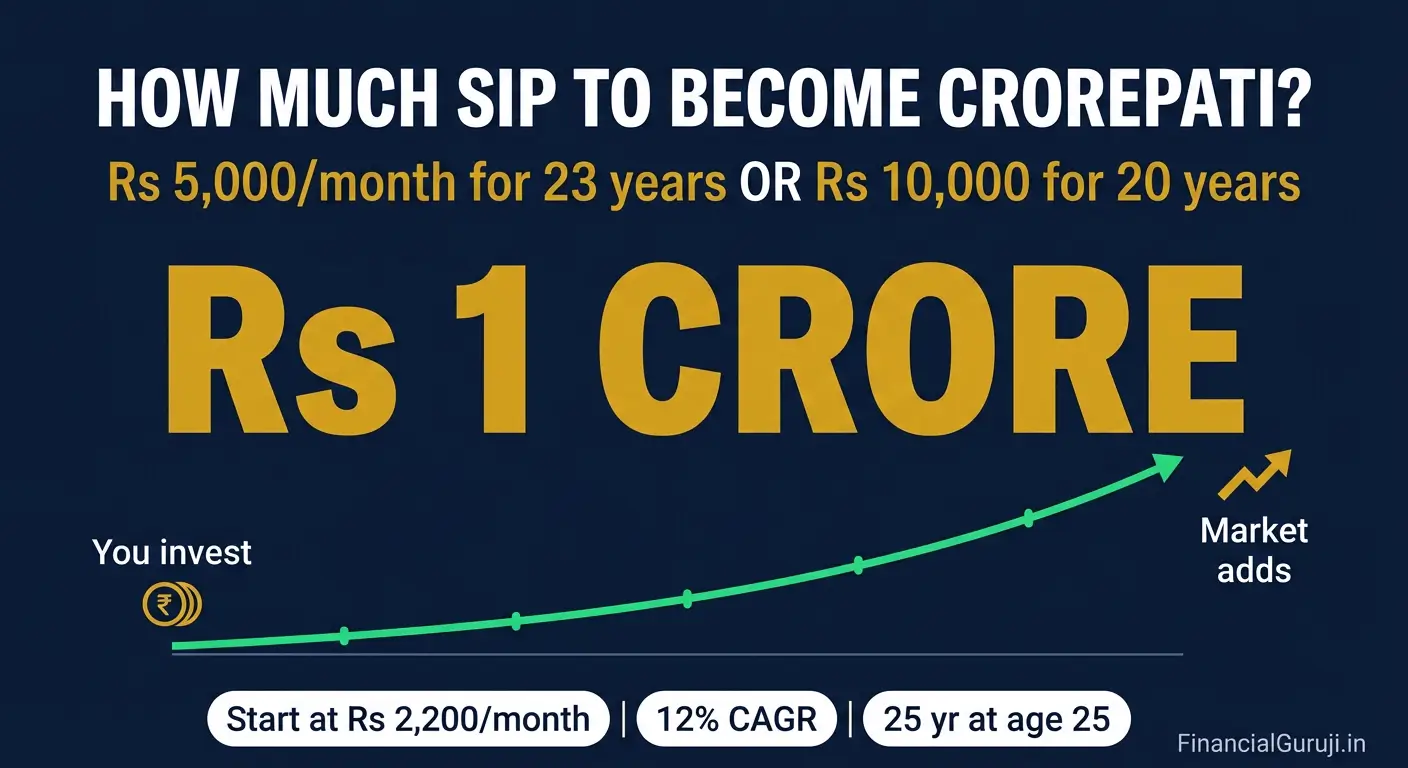
Rs 1 crore sounds like a lot. And it used to be. In 1990, Rs 1 crore was generational wealth. In 2026, Rs 1 crore is approximately what a mid-level IT professional in Hyderabad or Bengaluru earns in 4 to 5 years.
But as a retirement or financial independence target, Rs 1 crore is still meaningful — it generates approximately Rs 50,000 to Rs 60,000 per month in passive income at a 6% safe withdrawal rate. For most Indian families, that covers monthly expenses comfortably.
The question is not whether you should target Rs 1 crore. The question is how much SIP per month gets you there — and how many years it takes at your current income.
Here are the exact numbers.
The Core Principle — Compounding Does the Heavy Lifting
The most important thing to understand before looking at any SIP number: in long-term SIP investing, the market does most of the work for you. You contribute the seeds. Time and compounding grow the tree.
| Rs 10,000 SIP at 12% CAGR | Amount You Invested | Market Returns Added | Total Corpus |
| After 10 years | Rs 12,00,000 | Rs 11,23,000 | Rs 23,23,000 |
| After 15 years | Rs 18,00,000 | Rs 32,35,000 | Rs 50,35,000 |
| After 20 years | Rs 24,00,000 | Rs 75,91,000 | Rs 99,91,000 |
| After 25 years | Rs 30,00,000 | Rs 1,59,27,000 | Rs 1,89,27,000 |
| Notice what happens between year 20 and year 25. You invest just Rs 6 lakh more — but the corpus grows by Rs 89 lakh. That is compounding accelerating in the later years. This is why starting early and staying invested are the two most powerful things you can do. |
SIP Amount to Reach Rs 1 Crore — Full Table
Assuming 12% CAGR — conservative long-term equity mutual fund average. Use the SIP Calculator on this site for different return assumptions.
| Monthly SIP Amount | Years to Rs 1 Crore | Total You Invest | Returns Added by Market |
| Rs 3,000 | 26 years | Rs 9,36,000 | Rs 90,64,000 — market does 91% |
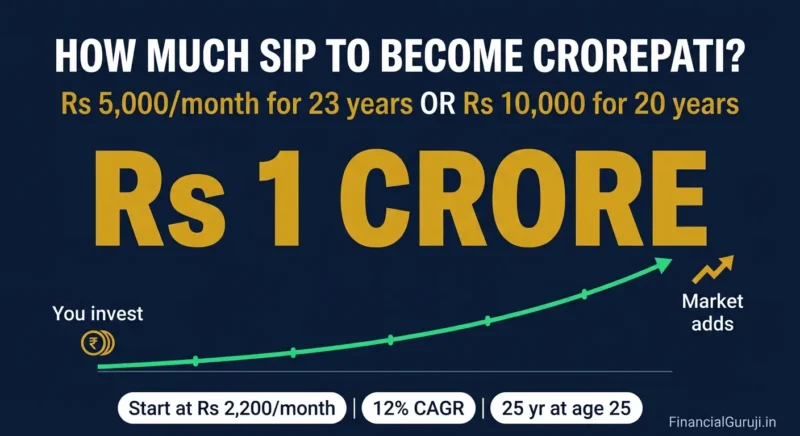
| Rs 5,000 | 23 years | Rs 13,80,000 | Rs 86,20,000 — market does 86% |
| Rs 7,500 | 21 years | Rs 18,90,000 | Rs 81,10,000 — market does 81% |
| Rs 10,000 | 20 years | Rs 24,00,000 | Rs 76,00,000 — market does 76% |
| Rs 15,000 | 18 years | Rs 32,40,000 | Rs 67,60,000 — market does 68% |
| Rs 21,000 | 15 years | Rs 37,80,000 | Rs 62,20,000 — market does 62% |
| Rs 32,000 | 12 years | Rs 46,08,000 | Rs 53,92,000 — market does 54% |
| Rs 57,000 | 10 years | Rs 68,40,000 | Rs 31,60,000 — market does 32% |
Key insight: A Rs 3,000 SIP investor who stays for 26 years lets the market contribute 91% of their Rs 1 crore. A Rs 57,000 SIP investor who wants it in 10 years has to contribute 68% themselves. Time is the most powerful lever — not the amount.
SIP by Salary — What You Should Target
A practical rule: invest 20% of take-home salary in equity SIP if your goal is long-term wealth. Here is what that looks like across different income levels and when it reaches Rs 1 crore:
| Monthly Take-Home | 20% SIP Amount | Years to Rs 1 Crore (12% CAGR) | Corpus at 25 Years |
| Rs 25,000 | Rs 5,000 | 23 years | Rs 94 lakh |
| Rs 40,000 | Rs 8,000 | 20-21 years | Rs 1.5 crore |
| Rs 60,000 | Rs 12,000 | 19 years | Rs 2.4 crore |
| Rs 80,000 | Rs 16,000 | 17-18 years | Rs 3.2 crore |
| Rs 1,00,000 | Rs 20,000 | 16-17 years | Rs 4 crore |
| Rs 1,50,000 | Rs 30,000 | 15 years | Rs 6 crore |
| Tip: If 20% feels too much right now — start with 10% and increase by 1% every 6 months. In 5 years you will be at 20% without ever feeling the pinch. This is the SIP step-up strategy applied to your savings rate, not just your SIP amount. |
Step Up SIP — The Fastest Route to Crorepati
Step up SIP (also called top-up SIP) means increasing your SIP amount by a fixed percentage every year — typically 10% to match salary increments. This single change dramatically reduces the time to reach Rs 1 crore.
| Strategy | Starting SIP | After 10 Years SIP | Years to Rs 1 Crore | Total Invested |
| Fixed SIP | Rs 10,000 | Rs 10,000 (unchanged) | 20 years | Rs 24,00,000 |
| Step-up SIP 10%/year | Rs 10,000 | Rs 25,937 (auto-grown) | 16 years | Rs 22,95,000 |
| Step-up SIP 15%/year | Rs 10,000 | Rs 40,456 (auto-grown) | 14 years | Rs 23,87,000 |
| Step up SIP 10% per year reaches Rs 1 crore 4 years earlier than a fixed SIP — and you actually invest LESS total money (Rs 22.95L vs Rs 24L). The growing SIP amount does more work in the compounding years. This is the single most powerful SIP optimization available. |
How to Set Up Step Up SIP
- Groww: SIP setup page > Enable Top-up > Enter 10% annual increase
- Zerodha Coin: Select Step-up SIP during fund selection
- Kuvera: SIP order > Step-up amount or percentage option
- Most AMC websites: Enable SIP top-up in the SIP registration form
Set the step-up to happen every April — aligned with your annual salary increment. You get a raise, your SIP gets a raise automatically.
The Rs 1 Crore SIP — Age-Wise Plan
How old are you today? Here is what you need to start investing to reach Rs 1 crore by age 60:
| Current Age | Years to Age 60 | Monthly SIP Needed (12% CAGR) | With 10% Step-up SIP |
| 25 years | 35 years | Rs 2,200/month | Rs 900/month start |
| 28 years | 32 years | Rs 3,100/month | Rs 1,400/month start |
| 30 years | 30 years | Rs 4,000/month | Rs 1,900/month start |
| 33 years | 27 years | Rs 5,700/month | Rs 2,900/month start |
| 35 years | 25 years | Rs 7,500/month | Rs 4,100/month start |
| 38 years | 22 years | Rs 11,000/month | Rs 6,500/month start |
| 40 years | 20 years | Rs 14,000/month | Rs 8,800/month start |
| 45 years | 15 years | Rs 21,000/month | Rs 15,000/month start |
A 25-year-old needs just Rs 2,200 per month — less than most people spend on eating out. A 45-year-old needs Rs 21,000 per month for the same goal. Every year you delay costs you roughly Rs 1,000 more per month in required SIP. The cost of waiting is real and compounding.
Rs 1 Crore is Just the Start — Multiple Crore Targets
Once you understand the SIP-to-crore math, scaling up is straightforward. Here is what different SIP amounts achieve at 12% CAGR over 20 years:
| Monthly SIP | 20-Year Corpus | 40-Year Corpus (if you continue) |
| Rs 5,000 | Rs 50 lakh | Rs 5.9 crore |
| Rs 10,000 | Rs 1 crore | Rs 11.8 crore |
| Rs 20,000 | Rs 2 crore | Rs 23.6 crore |
| Rs 30,000 | Rs 3 crore | Rs 35.4 crore |
| Rs 50,000 | Rs 5 crore | Rs 59 crore |
| Tip: Retirement planning tip: Do not stop SIP at Rs 1 crore. A Rs 1 crore corpus generating 7% annual returns gives Rs 58,000 per month. With 6% annual inflation, that Rs 58,000 is worth only Rs 32,000 in today’s money in 10 years. Target Rs 3 to Rs 5 crore for genuine retirement comfort in India 2026. |
Common SIP Mistakes That Delay the Crore
- Stopping SIP during market corrections — this is the single biggest wealth destroyer. A Rs 10,000 SIP stopped for 12 months during a correction delays the Rs 1 crore target by 2 to 3 years.
- Withdrawing SIP corpus for short-term goals — using long-term SIP money for a car, wedding, or vacation resets years of compounding. Maintain a separate short-term savings account for goals under 5 years.
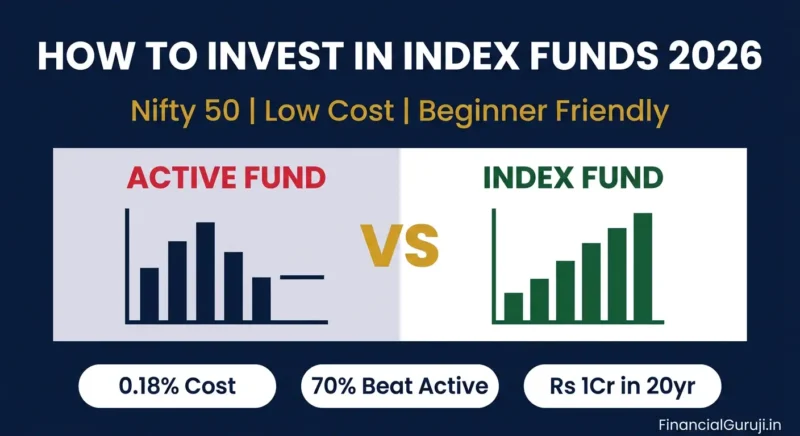
- Investing in too many funds — five SIP funds in different AMCs tracking similar indices is not diversification. One Nifty 50 index fund plus one midcap fund is sufficient for most investors.
- Not increasing SIP amount when income grows — if your salary doubles in 5 years but SIP stays the same, your wealth creation rate is falling as a percentage of income. Review and increase SIP every April.
- Chasing last year’s top performer — the fund that returned 45% last year is not likely to repeat. Consistent 12 to 14% CAGR over 10 years from a well-diversified fund beats a volatile 30% one year followed by -20% the next.
SIP vs FD — 20 Year Reality Check
| Rs 10,000 per month for 20 years | FD at 7% | Equity SIP at 12% | Difference |
| Total invested | Rs 24,00,000 | Rs 24,00,000 | Same |
| Corpus at 20 years | Rs 52,09,000 | Rs 99,91,000 | SIP gives Rs 47.8L more |
| Tax on gains | 30% on interest | 10% LTCG above Rs 1.25L/yr | FD far more taxed |
| Post-tax corpus (30%) | Rs 40,19,000 | Rs 95,00,000 approx | SIP wins by Rs 55L |
| Inflation-adj. value | Rs 22,00,000 | Rs 52,00,000 | SIP still 2.4x better |
The FD vs SIP debate is settled by this single table. Even at conservative 12% SIP returns versus 7% FD returns, the post-tax, inflation-adjusted difference after 20 years is enormous. FD has its place — for emergency fund and short-term goals. Not for 20-year wealth building.
Use our SIP Calculator — enter your monthly amount, return rate, and years to see your exact crorepati timeline
Frequently Asked Questions
How much SIP per month to get Rs 1 crore in 10 years?
At 12% CAGR, you need approximately Rs 57,000 per month SIP to reach Rs 1 crore in 10 years. In 15 years the same target needs Rs 21,000 per month. In 20 years it needs Rs 10,000 per month. The number drops sharply as you give it more time — start early and let compounding do the work.
Is Rs 5,000 SIP enough to become crorepati?
Yes — but it takes 23 years at 12% CAGR. Rs 5,000 per month for 23 years = Rs 13.8 lakh invested + Rs 86.2 lakh added by market returns = Rs 1 crore. If you increase that Rs 5,000 by 10% every year using step-up SIP, you reach Rs 1 crore in about 19 years instead.
What is step up SIP and how does it work?
Step up SIP meaning: you increase your monthly SIP amount by a fixed percentage every year — typically 10% to match annual salary increments. Most platforms allow this as an automatic setting. A Rs 10,000 SIP with 10% annual step-up becomes Rs 25,937 by year 10, reaching Rs 1 crore in 16 years instead of 20 — saving 4 years and actually investing less total money.
Which mutual fund is best for SIP to become crorepati?
For a long-term crorepati target, a combination works well: Nifty 50 index fund (60%) for stability and low cost + a midcap or flexicap active fund (40%) for additional growth. Avoid chasing recent top performers. Consistent 12 to 14% CAGR over 15 to 20 years is more valuable than volatile high returns.
What if the market gives less than 12% return on my SIP?
The 12% CAGR assumption is conservative for Indian equity over 15-20 year periods — Nifty 50 has delivered approximately 13-14% CAGR since inception. However, future returns are not guaranteed. If you get only 10% CAGR, a Rs 10,000 SIP reaches Rs 1 crore in about 22 years instead of 20. The goal shifts but remains achievable. Use the SIP Calculator with 10%, 12%, and 14% to see the range of outcomes.
Should I invest lumpsum or SIP to reach Rs 1 crore faster?
If you have a lumpsum available (inheritance, bonus, or savings), a one-time investment of Rs 10 lakh at 12% CAGR grows to Rs 1 crore in approximately 20 years without any monthly SIP. Combining lumpsum with ongoing SIP is the most powerful approach. Use lumpsum for the initial corpus and SIP for disciplined monthly additions.
Disclaimer: Mutual fund investments are subject to market risk. Past returns do not guarantee future performance. 12% CAGR is a historical average — actual returns may vary. Please consult a SEBI-registered financial advisor before investing.