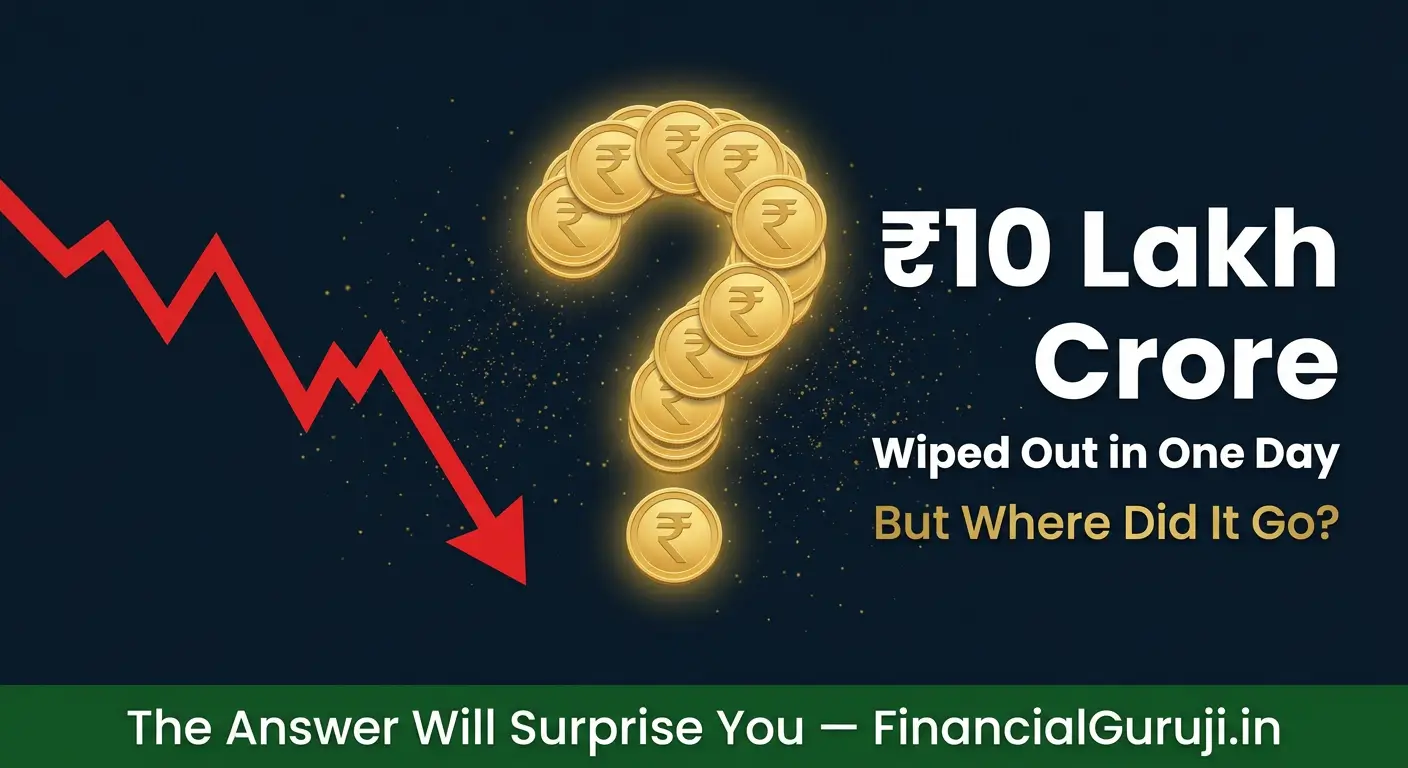
On March 19, 2026, Indian investors lost over ₹10 lakh crore on paper in a single session. Sensex crashed 2,500+ points. Nifty slipped to 23,090 — its lowest level in months.
And this came just days after the March 13 crash that wiped out ₹9.5 lakh crore.
Every newspaper screamed about wealth being “wiped out.” Every WhatsApp group had someone saying “so much money is gone.”
But here is the question nobody answers clearly:
Gone where, exactly?
Did someone take it? Did it disappear into thin air? Is it sitting in someone’s account right now?
The honest answer surprises most people — and understanding it will completely change how you think about market crashes.
The Most Important Thing to Understand First
Stock market “money” is not the same as money in your bank account.
When you deposit ₹1 lakh in a savings account, that ₹1 lakh physically exists somewhere. A bank holds it. You can withdraw it.
When Infosys stock is trading at ₹1,500 per share and you own 100 shares — your portfolio shows ₹1,50,000. But that ₹1,50,000 does not physically exist anywhere. It is a valuation — a number calculated by multiplying the current share price by the number of shares you hold.
When the share price falls to ₹1,200, your portfolio now shows ₹1,20,000. The ₹30,000 “loss” was never real money sitting in a vault somewhere. It was a paper valuation that changed.
This is why economists call it “paper wealth” — it is wealth on paper, not cash in a box.
So Where Does the Money Actually Go?
Here is what really happens during a market crash — broken down simply.
Part 1: Most of It Simply Disappears — It Was Never Real
Imagine a small town with 10 houses. Last year, all houses were selling for ₹50 lakh each. Total “wealth” of the town: ₹5 crore.
This year, due to a flood scare, buyers disappear. Houses now sell for ₹30 lakh. Total “wealth” of the town: ₹3 crore.
Did ₹2 crore go somewhere? No. The houses still stand. The families still live there. The ₹2 crore was a collective valuation — an agreement among buyers and sellers about what things are worth. When the agreement changed, the valuation changed. Nothing physically moved anywhere.
Stock markets work exactly the same way.
When Nifty falls 7%, the ₹25 lakh crore in “wiped out investor wealth” that newspapers report — most of it simply ceased to exist as a valuation. It was never real cash. It was a number on a screen based on what buyers were willing to pay.
Part 2: Some Money Moves to Sellers
Here is where it gets more specific. For a stock to fall in price, someone has to sell it. And for someone to sell, someone else has to buy.
When markets crash, this is what happens:
Sellers — panicking retail investors, foreign institutional investors (FIIs) exiting India, mutual fund redemptions — sell their shares.
Buyers — other investors, smart money, institutions buying at lower prices — receive those shares.
The seller gets cash. The buyer parts with cash. Cash changes hands between them — but it does not disappear.
In March 2026, FIIs sold over ₹46,100 crore worth of Indian equities in nine trading sessions. That money left India and went to:
- US treasury bonds (considered safe during war)
- Gold (safe haven asset — which is why gold hit ₹1,64,000/10g)
- Cash in foreign markets
Meanwhile, domestic institutional investors — Indian mutual funds and insurance companies — bought over ₹48,000 crore in the same period. They paid cash and received shares at lower prices.
Part 3: Some Money Goes to Short Sellers
A small portion of money during a crash goes to short sellers — traders who bet that prices will fall.
Short selling works like this: you borrow shares, sell them at the current high price, wait for the price to fall, buy them back at the lower price, return the borrowed shares, and keep the difference as profit.
When Nifty falls, short sellers profit at the expense of long investors. This is a zero-sum transfer — money moves from buyers who held positions to sellers who bet against the market.
Short selling is a small part of overall market activity — but it does explain where some money goes during sharp falls.
A Real Example — March 2026
Let us trace exactly what happened on March 13, 2026:
Morning: Iran war fears intensify. Crude oil crosses $115/barrel. Strait of Hormuz still closed.
9:15 AM: Markets open. FIIs start selling HDFC Bank, TCS, Reliance heavily.
What happens to FII money: FIIs sell ₹5,000 crore of Indian stocks. Indian buyers — mutual funds, retail investors — purchase those shares. FIIs receive ₹5,000 crore in cash, which they convert to dollars and move to US treasuries.
What happens to stock prices: More sellers than buyers means prices fall. Nobody wants to pay ₹1,600 for Infosys when fear is high — the best offer is ₹1,450. Price drops.
What happens to portfolio values: Every investor holding Infosys sees their portfolio value fall — even though they sold nothing and received nothing. Their paper wealth dropped.
End of day: Sensex down 1,460 points. ₹9.5 lakh crore in paper wealth gone. But most of that ₹9.5 lakh crore was never cash — it was a collective valuation that declined.
March 19, 2026 brought an additional layer of pain. Three fresh triggers hit simultaneously — HDFC Bank’s chairman Atanu Chakraborty resigned citing “ethical concerns,” sending the stock crashing 8% in a single session. Since HDFC Bank carries over 11% weightage in Nifty 50, its fall alone dragged the entire index down significantly. On top of that, the US Federal Reserve kept interest rates unchanged and signalled no rate cuts in the near term, killing hopes of a global liquidity rally. And Brent crude surged to $119.5 per barrel after reports emerged of drone attacks on Saudi Arabia’s Yanbu port and Aramco refineries. The result: Sensex down another 2,500 points. Nifty at 23,090. Over ₹10 lakh crore wiped out — in a single day. Again.
Why Does This Matter for Regular Investors?
Understanding this completely changes how you should react to crashes.
Your SIP did not lose real money unless you sold.
If you have ₹5 lakh in a Nifty 50 index fund and it is now showing ₹4.5 lakh — you have not lost ₹50,000. You still hold the exact same number of units. Those units represent ownership in 50 of India’s largest companies. Those companies still exist. They still generate revenue.
Your portfolio value fell because the price someone is willing to pay for those units fell temporarily. The moment sentiment improves, buyers return, and prices rise back.
The only way you actually lose money is if you sell during the crash and lock in that lower price permanently.
This is why “staying invested” is not just advice — it is mathematically correct.
Where Does Money Go During a Crash — Summary
| Money Type | What Actually Happens |
|---|---|
| Paper wealth (most of it) | Simply disappears — it was a valuation, not real cash |
| FII selling proceeds | Moves to safer assets — US bonds, gold, cash |
| Panic seller proceeds | Goes to smart buyers who purchased at lower prices |
| Short seller profits | Transfer from long investors to short sellers |
| Actual cash in the economy | Mostly unchanged — only valuations changed |
The Bigger Picture
India’s Sensex has crashed multiple times:
| Crash | Fall | Recovery |
|---|---|---|
| Harshad Mehta Scam 1992 | -72% | 7 years |
| 2008 Financial Crisis | -60% | 18 months |
| COVID Crash 2020 | -38% | 6 months |
| 2026 Iran War + HDFC Bank | ~12% so far | ? |
Every single time, the market recovered. The paper wealth that “disappeared” came back — and then grew beyond the previous peak.
The investors who understood that paper wealth is not real cash — and stayed invested — came out ahead every single time.
Key Takeaways
- Most “wealth wiped out” during crashes is paper wealth — valuations, not real cash
- Money does not disappear — it either moves between buyers and sellers or was simply a number that changed
- FII selling during India’s 2026 crash moved money to gold and US bonds — which is why gold surged
- Your portfolio loss is not real unless you sell and lock it in
- Every major Indian market crash has recovered — staying invested is mathematically correct
Disclaimer: This article is for informational and educational purposes only. It does not constitute investment advice. Please consult a SEBI-registered financial advisor before making any investment decisions.